

Watering an Anthurium: A Complete Guide to Frequency and Method
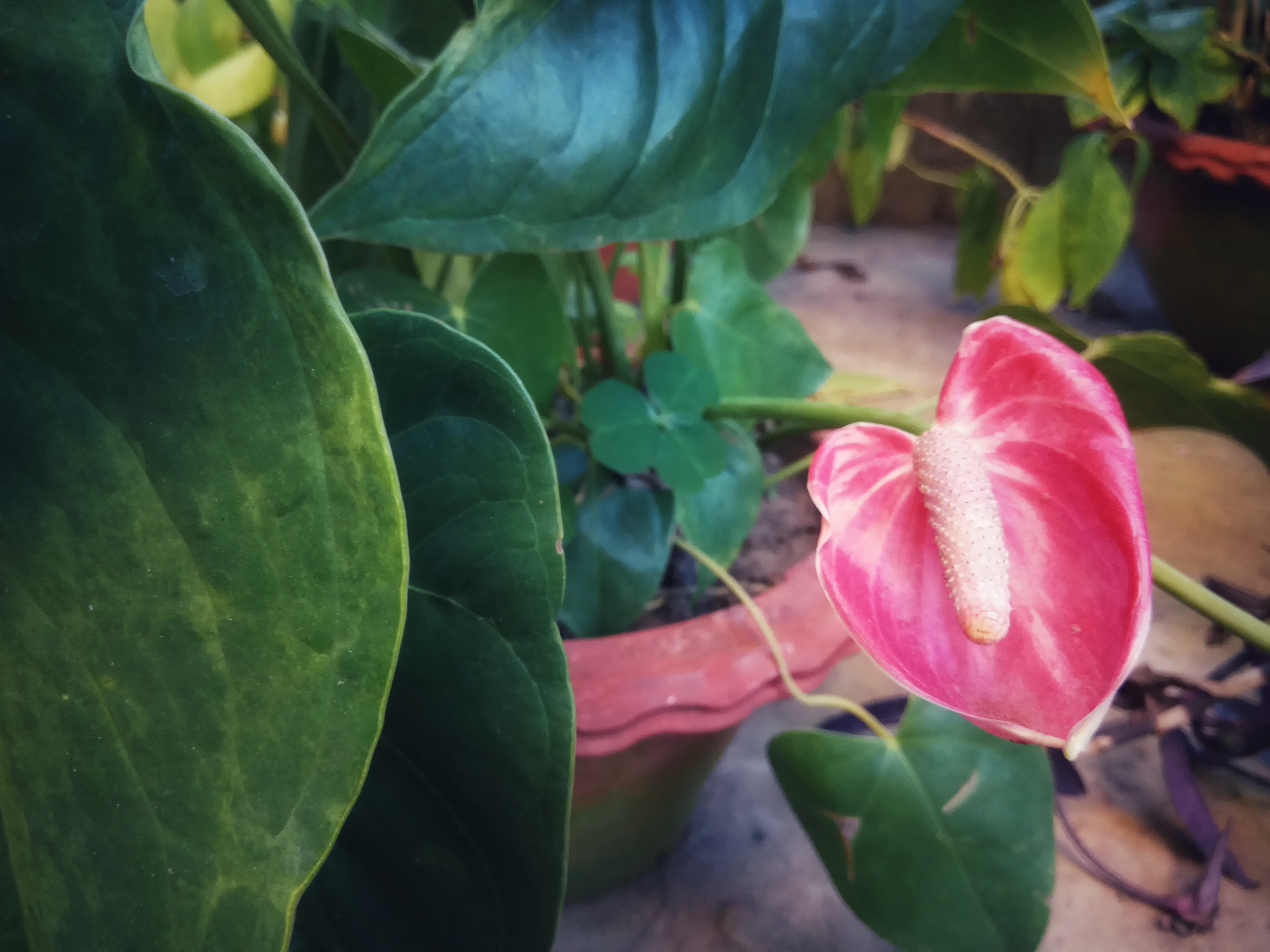
Anthurium (Anthurium andraeanum, the flamingo flower) is grown for one of the longest-lasting displays in the houseplant world: waxy red, pink, or white spathes that hold for weeks and appear more or less continuously in a well-kept plant[1][2]. It is also the plant most often killed with kindness. Anthurium is an epiphyte with roots built for air as much as for water, so it is genuinely prone to root rot — while at the same time being a humidity lover that hates dry air. This guide covers watering an anthurium properly: the frequency, the seasonal shifts, the warning signs on both sides, and the method that keeps those roots healthy.
Water an anthurium roughly every 7–10 days, once the top 1–2 inches of the mix have dried. Soak thoroughly until water runs from the drainage holes, then empty the saucer — anthurium roots are epiphytic and rot quickly if they sit wet. Stretch to every 10–14 days in winter. Keep humidity high (60%+) while keeping the soil only lightly moist; the two are separate needs. Anthurium is toxic to cats, dogs, and horses (insoluble calcium oxalates, ASPCA).
01 · THE SIMPLE ANSWER
How often to water an anthurium
In typical indoor conditions an anthurium needs water every 7–10 days. In a bright, warm room in summer it may want a drink weekly; in a cooler room or in low winter light the same plant can go 10–14 days and be perfectly happy[1][3]. The variance is real, so treat 7–10 days as a reminder to check rather than an instruction to pour.
The trigger is the top 1–2 inches of the mix. Push a finger in: dry at that depth means water thoroughly; still damp means wait and check again in two or three days. Anthurium wants a light, chunky, airy mix that dries at the surface while staying just barely moist deeper down — it should never be soggy and never bone-dry all the way through.
Do not confuse soil moisture with humidity. Anthurium is a genuine humidity lover, happiest above 60% relative humidity, and dry indoor air causes brown, crispy leaf tips no matter how carefully you water. Raising humidity is the correct fix for that symptom — watering more often is the wrong one, and the fastest route to root rot[4].
02 · THE BOTANY
Why anthurium roots hate wet soil
Anthurium andraeanum is an epiphytic aroid from the wet tropical forests of Colombia and Ecuador, where it grows anchored to tree trunks and branches rather than rooted in soil[5][6]. In that habitat the roots are drenched by daily rain and then drain and dry within hours, surrounded by moving humid air. They are thick, fleshy, and adapted to take up water fast and breathe between soakings — not to sit in a saturated pot.
That is the whole explanation for anthurium's reputation. Packed into dense, water-retentive potting compost, those epiphytic roots are starved of oxygen, and oxygen-starved roots are quickly colonised by Pythium and Phytophthora rots[7]. The single most effective thing you can do for an anthurium has nothing to do with the watering can: pot it in a chunky, airy medium — orchid bark, perlite, coco chips, a little peat or coir — in a container with generous drainage.
The forest canopy also explains the humidity requirement. High ambient moisture means anthurium leaves lose water slowly, so the plant never evolved thick cuticles or other drought armour. Dry centrally heated air pulls moisture from those thin leaves faster than the roots resupply it, browning the margins. Aerial roots emerging above the mix are entirely normal, by the way — they are the plant behaving like the epiphyte it is, and a sign it would like more humidity and a chunkier medium, not more water.

One caution worth knowing before you handle the plant: like most aroids, anthurium tissue contains insoluble calcium oxalate crystals. The sap can irritate skin, and the ASPCA lists anthurium as toxic to cats, dogs, and horses — chewing causes oral pain, drooling, and swelling[8].
03 · SEASONAL SCHEDULE
Anthurium watering schedule by season
Anthurium grows year-round indoors but slows markedly in low winter light. These are working ranges for a plant in a bright indirect position — always confirm with the finger test before watering[3][9].
01 · Spring (Mar–May)
Every 7–10 days
Growth and bud production resume as light returns. Resume feeding lightly and keep moisture steady.
02 · Summer (Jun–Aug)
Every 5–7 days
Peak demand in warm, bright rooms. Air conditioning dries the air, so watch humidity as well as the mix.
03 · Fall (Sep–Nov)
Every 7–12 days
Light drops and so does water use. Start extending the interval rather than watering on the old schedule.
04 · Winter (Dec–Feb)
Every 10–14 days
Minimal growth — the highest-risk season for root rot. Keep humidity up while cutting watering back.
04 · FACTORS THAT MATTER
Six factors that change how often you water an anthurium
Light level: The biggest driver. An anthurium in bright indirect light transpires steadily and dries in about a week; the same plant in a dim corner may stay damp for a fortnight. If you have just moved the plant, reset the schedule — see anthurium light requirements.
Potting medium: A chunky bark-and-perlite aroid mix drains and dries in days; dense peat-heavy compost holds water for weeks. Two anthuriums on the same windowsill can need completely different intervals purely because of what they are potted in.
Humidity: Above 60% the plant loses water slowly and needs less frequent watering; in dry winter air it dries faster and browns at the tips. Raise humidity with a pebble tray, grouping, or a humidifier — do not compensate by soaking the roots.
Pot size and material: Terracotta breathes and dries fastest, which suits anthurium's epiphytic roots well. Glazed or plastic pots hold moisture much longer — and an oversized pot full of wet mix around a small root ball is the classic root-rot setup.
Temperature and airflow: Anthurium wants 65–80°F and gentle air movement. Cold rooms below 60°F slow water use dramatically, so the same watering routine that worked in August becomes overwatering in a chilly December room.
Plant size and root fill: A mature, root-filled anthurium in bloom drinks far more than a young division in fresh mix. Anthurium actually flowers better slightly pot-bound, and a well-filled pot also dries at a more predictable rate.

05 · UNDERWATERING SIGNS
Signs your anthurium needs water
Anthurium is less theatrical than a wilting coleus, but it does signal thirst clearly if you look[10]:
- Drooping leaves and softening stalks. The whole plant loses its upright poise and the glossy leaves hang. Recovery is usually complete within a day of a thorough soak.
- Crispy brown leaf tips and margins. Often dry air rather than dry soil — check the mix first. If it is dry, water; if it is moist, the answer is more humidity, not more water.
- Blooms fading and dropping early. A spathe that should last weeks collapses in days when the plant is water-stressed, and new buds abort before opening.
- A very light pot and mix pulling from the sides. Bark-based mixes turn hydrophobic when fully dry, so water runs down the gap and straight out. Bottom-soak the pot for 20–30 minutes to rewet the root ball.
06 · OVERWATERING SIGNS
Signs you’ve overwatered your anthurium
Overwatering is the leading cause of anthurium death, and because the plant is marketed as a moisture-loving tropical it is an easy mistake to make[7][11]:
- Yellowing lower leaves in permanently damp mix. Whole leaves turning uniformly yellow from the bottom up, with soil that never dries, is the signature of failing roots — not a feeding issue.
- Drooping despite wet soil. The most confusing symptom. Rotted roots cannot take up water, so an overwatered anthurium looks exactly like a thirsty one. Always check the mix before watering again.
- Brown, mushy roots and a sour smell. Slide the plant out of the pot: healthy anthurium roots are firm and pale. Soft, dark, foul-smelling roots confirm rot — cut them away and repot into fresh chunky mix.
- Fungus gnats and a surface that is always damp. Small flies circling the pot mean the top layer never dries. Extend the interval and check that drainage holes are clear.

If rot has set in, act on the medium rather than the schedule: trim damaged roots, repot into a fresh airy aroid mix, remove the saucer, and let the top 2 inches dry properly before the next soak. For the full recovery protocol see how to stop overwatering houseplants.
07 · THE METHOD
How to actually water an anthurium
Water thoroughly, not sparingly. Pour evenly over the whole surface until water runs freely from the drainage holes — roughly 1–2 cups (250–500 ml) for a 6-inch pot[12]. Small, timid sips wet only the surface and leave the lower root ball dry, which is one of the quieter causes of a chronically unhappy anthurium.
Empty the saucer or decorative cover pot within 15 minutes, every time. This is the single most important habit for anthurium: standing water is what turns a good soak into root rot.
Use room-temperature water, and rainwater or filtered water if your tap is very hard. Anthurium is moderately sensitive to salt and mineral build-up, which shows up as brown leaf tips that look like — but are not — a humidity problem.
Raise humidity separately from watering. A pebble tray, a group of plants, a humidifier, or a bright bathroom all work. Occasional misting does little on its own, and water sitting in the crown or on the spathes can encourage fungal spotting.
Refresh the medium every 2–3 years. Bark-based aroid mixes break down over time into fine, water-holding particles — the same mix that drained beautifully when new becomes a rot risk once it has composted down.
08 · TEMPERAMENT & QUICK FACTS
What an anthurium is really like
Anthurium andraeanum belongs to the arum family (Araceae) and is native to the humid tropical forests of Colombia and Ecuador, where it grows as an epiphyte in the mid-canopy[5][13]. It is hardy only in USDA zones 11–12, so outside the tropics it is strictly a houseplant — and its entire personality follows from that origin: warmth, humidity, filtered light, and roots that want air.
As a plant to live with, anthurium is showy but particular. Its great virtue is the display: a well-lit plant produces spathes almost continuously, each lasting six to eight weeks, so it is rarely out of flower. Its quirks are consistency-related rather than difficult — it wants steady warmth above 60°F, no cold draughts, high humidity, and a medium that never stays soggy. Give it those and it is remarkably long-lived. Expect a mature plant to reach 12–18 inches tall and wide, with dwarf cultivars staying under a foot and some large-leaved types reaching 2–3 feet. It flowers best slightly pot-bound, so resist repotting too often, and propagate by division at repotting time rather than from cuttings.
On cultivars, the classic red-spathed forms sit alongside a huge modern range: white 'Champion White', pink and coral selections, deep near-black 'Black Beauty' types, and the tulip-shaped Anthurium andreanum hybrids sold as compact pot plants. Related species are grown mainly for foliage — Anthurium clarinervium and A. crystallinum for their velvet, white-veined leaves — and they share the same epiphytic root needs. One important note for pet households: anthurium contains insoluble calcium oxalate crystals and is listed by the ASPCA as toxic to cats, dogs, and horses, causing oral irritation, drooling, and swelling if chewed; the sap can also irritate human skin, so wear gloves when dividing[8].
For a quick-reference take on frequency alone, see our companion post on how often to water an anthurium, and pair it with anthurium light requirements — light sets the pace that watering follows.
ACQUATERRA
Gentle, even root-zone moisture — the middle ground between soggy mix and a bone-dry anthurium.
Shop AcquaTerra →Watering an anthurium well comes down to three habits: check the top 1–2 inches before every watering, soak thoroughly and drain completely, and treat humidity as a separate need from soil moisture. Every 7–10 days is the working range, stretching to 10–14 in winter, but the light, the mix, and the pot decide the real number. Keep those epiphytic roots airy and an anthurium will flower for years. Related reading: anthurium light requirements.
Frequently asked questions
How often should I water an anthurium?
Every 7–10 days in most homes, once the top 1–2 inches of mix are dry. Stretch to 10–14 days in low winter light, and check every 5–7 days in a warm, bright room in summer.
How much water does an anthurium need?
Roughly 1–2 cups (250–500 ml) for a 6-inch pot — enough to run freely from the drainage holes. Water thoroughly rather than little and often, then empty the saucer within 15 minutes.
Why are my anthurium leaves turning yellow?
Uniform yellowing of lower leaves in mix that never dries points to overwatering and root rot. Check the roots: firm and pale is healthy, brown and mushy means repot into fresh chunky aroid mix and water less often.
Why are my anthurium leaf tips brown and crispy?
Usually low humidity or salt build-up from hard tap water, not thirst. Raise humidity above 60% with a pebble tray or humidifier and switch to rainwater or filtered water — do not water more frequently.
Can you overwater an anthurium?
Yes — it is the most common way anthuriums die. Their roots are epiphytic and need air, so soggy mix quickly leads to root rot. Let the top 1–2 inches dry, use a chunky bark-based mix, and never leave the pot standing in water.
Do anthuriums like humidity?
Very much — they are happiest above 60% relative humidity. Use a pebble tray, group plants together, run a humidifier, or grow the plant in a bright bathroom. Humidity is a separate need from soil moisture.
Is anthurium toxic to pets?
Yes. The ASPCA lists anthurium as toxic to cats, dogs, and horses because of insoluble calcium oxalate crystals, which cause oral pain, drooling, and swelling if chewed. The sap can also irritate skin.
References
- [1] Missouri Botanical Garden. (n.d.). Anthurium andraeanum — Plant Finder. missouribotanicalgarden.org.
- [2] Royal Horticultural Society. (n.d.). Anthurium / RHS Gardening. rhs.org.uk.
- [3] University of Florida IFAS Extension. (n.d.). Anthurium production and care. edis.ifas.ufl.edu.
- [4] Clemson Cooperative Extension. (n.d.). Indoor plants — humidity and watering. Home & Garden Information Center. hgic.clemson.edu.
- [5] Royal Botanic Gardens, Kew. (n.d.). Anthurium andraeanum Linden ex André. Plants of the World Online. powo.science.kew.org.
- [6] USDA, Agricultural Research Service. (2023). GRIN: Anthurium andraeanum. npgsweb.ars-grin.gov.
- [7] North Carolina State Extension. (n.d.). Anthurium andraeanum. plants.ces.ncsu.edu.
- [8] ASPCA. (n.d.). Flamingo flower (Anthurium) — toxic to dogs, cats, and horses. aspca.org.
- [9] University of Wisconsin–Madison Division of Extension. (n.d.). Anthurium, Anthurium andraeanum. hort.extension.wisc.edu.
- [10] University of Minnesota Extension. (2022). Watering houseplants. extension.umn.edu.
- [11] Michigan State University Extension. (n.d.). Overwatering and root rot in houseplants. canr.msu.edu.
- [12] Penn State Extension. (2020). Houseplant Care: Watering, Fertilizing, and Repotting. extension.psu.edu.
- [13] Croat, T.B. (1988). Ecology and life forms of Araceae. Aroideana, 11, 4–55.
- [14] Taiz, L., & Zeiger, E. (2010). Plant Physiology, 5th ed. Sinauer Associates.
- [15] Lambers, H., Chapin, F.S., & Pons, T.L. (2008). Plant Physiological Ecology, 2nd ed. Springer.