

How Often to Water an Anthurium: Schedule, Signs, and Factors That Matter
Anthuriums (Anthurium andraeanum and related species) are among the most striking flowering houseplants in cultivation, producing waxy heart-shaped spathes in vivid red, pink, white, or orange that can persist for weeks at a time. Watering is the variable most owners get wrong: anthuriums want consistent moderate moisture with excellent drainage and air around the roots[1][2]. This guide tells you how often to water an anthurium based on the horticultural research, what variables actually change the schedule, and how to recognize the early signs that something is off.
Water an anthurium every 7–10 days when the top inch of soil is dry. Spring and summer: every 7–10 days. Fall and winter: every 10–14 days. Anthuriums want lightly moist roots with excellent drainage — not soggy, not bone-dry. Use a chunky aroid mix and never let the pot sit in standing water.
01 · THE SIMPLE ANSWER
How often to water an anthurium
In typical indoor conditions — bright indirect light, household temperatures of 65–80°F, and a coarse aroid potting mix — an anthurium needs water every 7–10 days during active growth and every 10–14 days during cooler months[1][2]. The plant prefers consistent light moisture rather than the soak-and-dry cycle that suits monsteras or pothos.
Anthurium andraeanum is native to the rainforests of Colombia and Ecuador, where it grows as an epiphyte on tree trunks and branches at mid-canopy elevations[3][4]. Its native habitat is humid and consistently moist but never waterlogged — roots wrapped around bark drain instantly after rain. This is the indoor target: moisture available to roots, but never sitting in saturated soil.
Use the finger test: stick a finger 1 inch into the soil. If the top is dry but you feel moisture below, water. If still moist at the surface, wait 2–3 days. Anthuriums recover quickly from brief drought but suffer cumulatively from chronic overwatering — root rot is the leading cause of anthurium decline[5].
02 · THE BOTANY
Why anthuriums need air around their roots
Anthurium roots are adapted for life on tree bark. In the wild, they wrap around trunks where water flows past quickly and air circulates constantly[6]. The roots are velamen-coated (similar to orchid roots) and can briefly absorb large amounts of water before drying again. Pot them in dense soil that holds water against the roots constantly and they suffocate — the classic root rot decline.
This is why soil mix matters more for anthuriums than for almost any common houseplant. A standard houseplant potting mix retains too much water and chokes the roots. An aroid-friendly mix — chunky bark, perlite, coco coir, and minimal fine peat — replicates the bark-and-air-pocket environment anthurium roots evolved for[7].
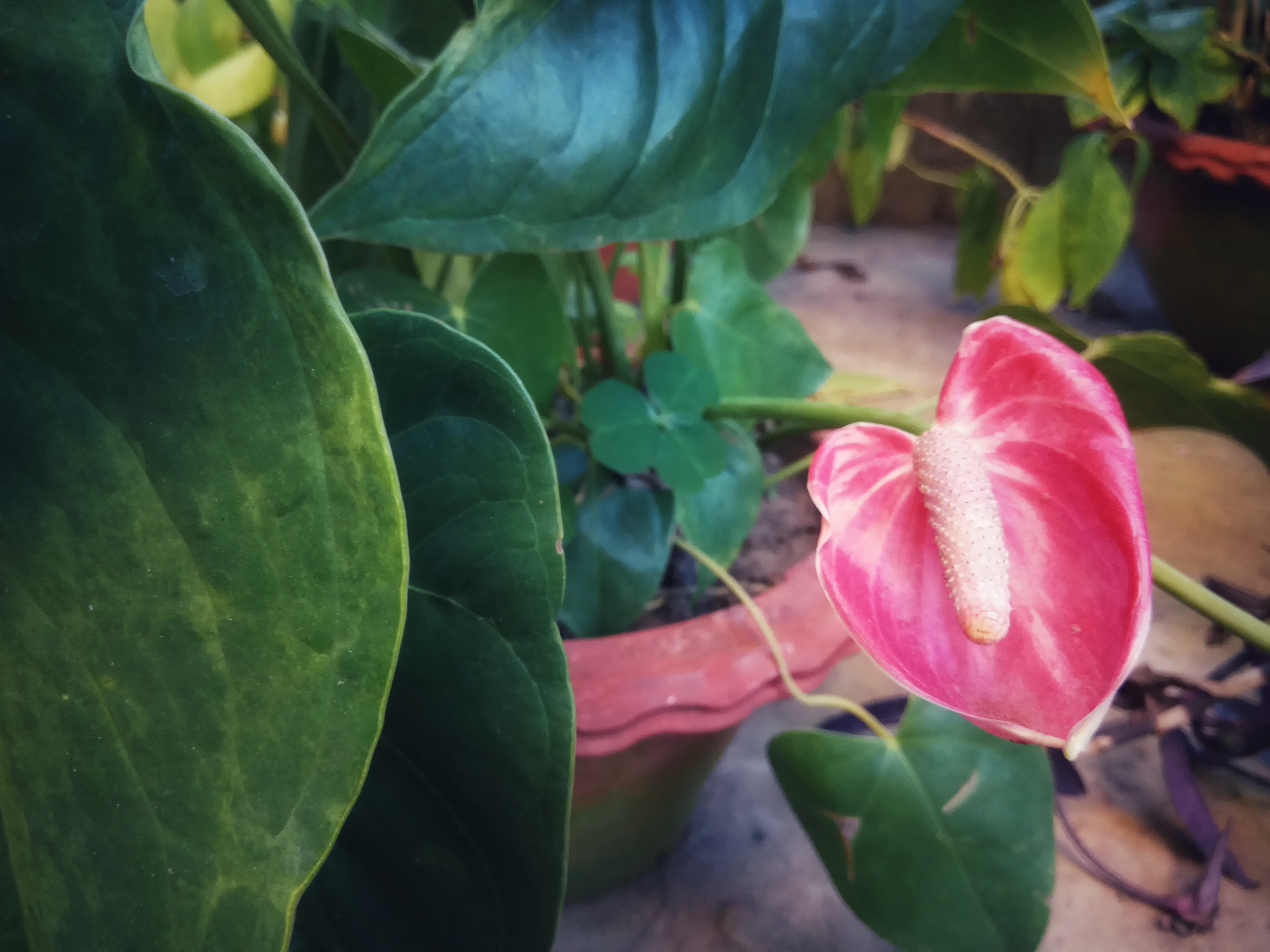
The plant’s iconic spathe (the colorful heart-shaped “flower”) is actually a modified leaf called a bract, not a true flower. The true flowers are the tiny structures clustered on the cylindrical spadix at the spathe’s center[8]. A single spathe can persist 6–8 weeks under good conditions and a well-cared-for anthurium produces 4–6 spathes per year — if watering is consistent. Inconsistent watering causes both bud abortion and short-lived blooms.
Anthurium clarinervium and other foliage-anthuriums share the same watering preferences as flowering anthuriums, despite their dramatically different appearance. The genus-wide preference for chunky soil with consistent light moisture applies across all common anthurium species in cultivation.
03 · SEASONAL SCHEDULE
Anthurium watering schedule by season
Below are typical intervals for an established anthurium in a 6–8 inch pot of aroid mix[1][2].
01 · Spring (Mar–May)
Every 7–10 days
Growth resumes. New leaves emerge. Increase frequency gradually from winter cadence.
02 · Summer (Jun–Aug)
Every 5–7 days
Peak bloom and growth. Warm temperatures accelerate water use.
03 · Fall (Sep–Nov)
Every 10–14 days
Growth slows as light decreases. Stretch intervals progressively.
04 · Winter (Dec–Feb)
Every 14–21 days
Minimal growth. Cool rooms substantially reduce water demand.
04 · FACTORS THAT MATTER
Six factors that change how often you water an anthurium
Soil mix: The single biggest variable. Standard houseplant soil dramatically slows watering frequency because it holds water against roots — but it’s exactly the wrong soil for anthurium long-term health. A chunky aroid mix (50% orchid bark, 25% perlite, 25% coco coir is one common formula) drains faster, meaning you water more often, but the plant thrives[7].
Light: Bright indirect light produces faster growth and faster water cycling. Anthuriums in dim corners water-cycle slower and bloom poorly. East-facing windows are ideal.
Pot size and material: Larger pots dry slower. Unglazed terra cotta dries faster than plastic or glazed ceramic. Anthuriums prefer to be slightly snug in their pots.
Humidity: Anthuriums prefer 60–80% humidity — substantially higher than most homes provide in winter. Lower humidity causes leaf-edge browning but doesn’t dramatically shift watering frequency. A humidifier or pebble tray helps appearance more than watering schedule.
Temperature: Warm rooms (75°F+) accelerate water use; cool rooms slow it. Below 60°F, anthuriums slow dramatically and may stop blooming entirely until temperatures rise.
Active bloom: Plants with multiple developing spathes use slightly more water than vegetative plants. Heavily blooming anthuriums may need watering every 5–7 days even in cool months.
05 · UNDERWATERING SIGNS
Signs your anthurium needs water
Anthuriums give moderate thirst signals.[9]
- Leaves lose firmness or droop. Earliest reversible thirst signal. Leaves angle downward and lose their characteristic glossy upright posture. Watering reverses within hours.
- Brown crispy leaf edges. Chronic mild drought combined with dry air browns leaf margins. The damage is permanent on affected leaves but new growth will be normal once watering and humidity improve.
- Spathes age faster than usual. Stressed anthuriums abandon spathes early — a bloom that should persist 6–8 weeks may fade in 2–3 weeks under chronic mild drought.
- Reduced new growth and bud production. Chronic mild water stress reduces both leaf production and spathe development. The plant survives but performs poorly until watering returns to schedule.
06 · OVERWATERING SIGNS
Signs you’ve overwatered your anthurium
Overwatering — especially in dense soil — is the leading cause of anthurium decline[5][10].
- Yellowing leaves emerging in succession. Multiple leaves yellowing — especially from the base — signals root rot. A single yellow leaf is normal aging.
- Soft mushy base of leaf petioles. Petioles should be firm where they emerge from the soil. Softness signals rot reaching the crown — cut affected leaves at the base and inspect.
- Persistent soil sogginess. Soil that stays wet for over a week post-watering indicates either too-dense soil mix or chronic overwatering. Repot into chunky aroid mix.
- Foul or musty smell from soil. Rotting roots produce a distinct musty odor. If detected, unpot immediately, trim damaged roots, and repot in fresh aroid mix.
Recovery requires unpotting, trimming damaged roots, and repotting in a coarse aroid mix that provides the air pockets anthurium roots need. See how to stop overwatering houseplants for the complete protocol.
07 · THE METHOD
How to actually water an anthurium
Water thoroughly until water drains from the pot’s holes — usually 1.5–2 cups (350–475 ml) for a 6-inch pot[11]. Chunky aroid mix drains fast, so water often runs through quickly. Run water through the pot until it’s evenly wet, then let drain completely.
Bottom watering works exceptionally well for anthuriums in chunky aroid mix. Set the pot in a basin for 20–30 minutes, let the soil and bark absorb water evenly, then drain. This avoids the channeling problem that top-watering can produce in coarse media.
Drain saucers immediately after watering. Anthurium roots sitting in standing water rot quickly.
Use room-temperature water. Cold tap water can shock tropical roots, particularly in winter. Anthuriums are mildly sensitive to fluoride and chlorine — filtered or rainwater is preferable if your supply is heavily chlorinated.
Aerial roots that emerge above the soil are normal and should be misted occasionally rather than buried. Healthy anthurium aerial roots are firm and gray-brown.
08 · AWAY FROM HOME
Watering your anthurium while you’re away
Anthuriums handle short absences (up to 1 week) well if watered deeply 24 hours before departure. For trips of 2–4 weeks, an AcquaTerra terracotta watering spike delivers consistent moisture without saturation risk — particularly valuable for anthuriums because consistency is their key preference.
For complete vacation protocols for anthuriums, see how to water an anthurium while away. For broader indoor plant trip planning, see how to care for indoor plants while on vacation and how to care for houseplants while on vacation. For tropical houseplants generally, see indoor plant watering system for monstera and philodendrons.
The most common anthurium vacation watering mistake: drowning the rootball before leaving. Anthuriums respond to this with the most reliable root rot of any common houseplant. Single thorough watering, or a self-watering spike. Never both.
Anthurium watering is more about soil mix than schedule. A chunky aroid mix lets you water freely without root rot risk; standard houseplant soil sets up chronic overwatering even with careful scheduling. Water every 7–10 days when the top inch is dry, use bright indirect light, and accept that humidity matters. For vacation specifics, see how to water an anthurium while away. For overwatering recovery, see how to stop overwatering houseplants.
Frequently asked questions
How often should I water an anthurium?
Water every 7–10 days when the top inch of soil is dry. Spring and summer: every 5–10 days. Fall and winter: every 10–14 days. Anthuriums prefer consistent light moisture, not soak-and-dry cycles.
How do I know when my anthurium needs water?
Stick a finger 1 inch into the soil. If dry at the surface, water. If still moist, wait 2–3 days. Drooping leaves are a reliable early thirst signal.
Why isn’t my anthurium blooming?
Most common causes: insufficient light, inconsistent watering, low humidity, or wrong soil mix. Anthuriums in standard houseplant soil often decline before blooming — repot into a chunky aroid mix and provide bright indirect light.
What soil is best for anthuriums?
A chunky aroid mix: roughly 50% orchid bark, 25% perlite, 25% coco coir or sphagnum moss. Standard houseplant soil retains too much water against the roots and causes chronic root rot.
How much water does an anthurium need?
Approximately 1.5–2 cups (350–475 ml) per watering for a 6-inch pot, or enough to drain freely from the pot’s holes. Chunky aroid mix drains fast, so water often runs through quickly.
Should I mist my anthurium?
Misting helps slightly with humidity and supports aerial root health, but a humidifier or pebble tray is more effective for the high humidity (60–80%) anthuriums prefer. Misting doesn’t replace proper watering.
How often to water an anthurium in winter?
Every 14–21 days in winter, sometimes longer in cool rooms or low light. Anthuriums slow substantially as light decreases.
What happens if I overwater my anthurium?
Root rot, marked by yellowing leaves, soft petiole bases, persistent soggy soil, and musty smell. Recovery requires unpotting, trimming damaged roots, and repotting in fresh chunky aroid mix. See how to stop overwatering houseplants for the protocol.
References
- [1] Royal Horticultural Society. (n.d.). Anthurium andraeanum / RHS Gardening. rhs.org.uk.
- [2] Missouri Botanical Garden. (n.d.). Anthurium andraeanum — Plant Finder. missouribotanicalgarden.org.
- [3] Croat, T.B. (1991). A revision of Anthurium for Mexico and Middle America, Part I. Annals of the Missouri Botanical Garden, 78(2), 539–855.
- [4] Higaki, T., Lichty, J.S., & Moniz, D. (1994). Anthurium culture in Hawaii. CTAHR Research Extension Series 152. University of Hawaii.
- [5] Daughtrey, M.L., & Benson, D.M. (2005). Principles of plant health management for ornamental plants. Annual Review of Phytopathology, 43, 141–169.
- [6] Mayo, S.J., Bogner, J., & Boyce, P.C. (1997). The Genera of Araceae. Royal Botanic Gardens Kew.
- [7] University of Florida IFAS Extension. (2018). Anthurium production guide. edis.ifas.ufl.edu.
- [8] Henley, R.W., Poole, R.T., & Chase, A.R. (1991). Foliage Plant Research at the University of Florida. UF/IFAS Extension.
- [9] Penn State Extension. (2020). Houseplant Care: Watering, Fertilizing, and Repotting. extension.psu.edu.
- [10] Lambers, H., Chapin, F.S., & Pons, T.L. (2008). Plant Physiological Ecology, 2nd ed. Springer.
- [11] North Carolina State Extension. (2022). Anthurium andraeanum. plants.ces.ncsu.edu.
- [12] Croat, T.B., & Sheffer, R.D. (1983). The sectional groupings of Anthurium (Araceae). Aroideana, 6(3), 85–123.
- [13] Royal Botanic Gardens, Kew. (n.d.). Anthurium andraeanum Linden ex André. Plants of the World Online. powo.science.kew.org.
- [14] USDA, Agricultural Research Service. (2023). GRIN: Anthurium andraeanum. npgsweb.ars-grin.gov.
- [15] Wolverton, B.C. (1996). How to Grow Fresh Air: 50 House Plants that Purify Your Home or Office. Penguin Books.