

Anthurium Light Requirements: A Complete Guide to Light for Blooms
If your anthurium has stopped flowering, light is almost certainly the reason. Understanding anthurium light requirements is what separates a plant that pushes out a fresh red, pink, or white spathe every few weeks from one that sits in a corner producing nothing but leaves. Anthurium (Anthurium andraeanum, the flamingo flower) wants bright, indirect light — genuinely bright, but never direct sun, which scorches its glossy foliage and bleaches its blooms[1][2]. This guide covers exactly how much light an anthurium needs, where to place it, and how light drives continuous blooming.
Anthurium light meter
Anthurium light requirements in one line: bright, indirect light for 8–10 hours a day is ideal, and it is what triggers continuous blooming. Anthurium tolerates medium light but flowers far less there, and it should never sit in direct sun, which scorches the leaves and fades the spathes. Too little light means healthy-looking foliage and few or no flowers — the single most common anthurium complaint.
01 · THE SIMPLE ANSWER
How much light does an anthurium need?
An anthurium needs bright, indirect light for roughly 8–10 hours a day — the sort of brightness you get right beside an east-facing window, or a few feet back from a south or west window behind a sheer curtain[1][3]. A useful test: at midday you should be able to read comfortably in that spot without switching on a lamp, but the sun's disc should not shine directly onto the leaves.
That brightness is not just for looks — it is the flowering trigger. Anthurium blooms more or less continuously when its light budget allows, producing a new inflorescence from each maturing leaf axil. Drop the light and the plant keeps making leaves but stops committing energy to spathes[4]. That is why "my anthurium is healthy but won't flower" is nearly always a light problem, not a fertiliser problem.
The reason it wants bright light without direct sun is its origin. Anthurium andraeanum is an epiphytic aroid from the wet tropical forests of Colombia and Ecuador, where it grows on trunks and branches in the mid-canopy — bathed in filtered, dappled brightness under a screen of leaves above[5][6]. Its thin, glossy leaves evolved for that filtered light and have no defence against unfiltered midday sun.
02 · THE LIGHT METER
Anthurium light levels, from deep shade to full sun
The easiest way to think about anthurium light needs is a spectrum. Here is where an anthurium wants to sit on it — the outlined band marks the ideal light conditions:
Anthurium light meter
An anthurium occupies a narrower band than a tough foliage plant. It thrives in bright, indirect light, tolerates medium light at the cost of blooming, and struggles at both ends: low light and deep shade mean no flowers and slow, small leaf growth, while direct sun burns the foliage within days[2][7]. Only gentle early-morning sun is safe. If you remember one thing about anthurium lighting, make it this: as bright as you can manage, as long as the sun never lands directly on the leaves.
03 · LIGHT BY WINDOW
The best window and placement for anthurium light
Which window gives the right light for an anthurium? Window direction is the fastest way to estimate the light conditions a spot provides (for the Northern Hemisphere — reverse for the Southern)[8]:
East window
✓ Ideal
Soft morning sun then bright indirect light all day. The best anthurium light placement for continuous blooms.
South window
△ Filter it
Excellent brightness, but only behind a sheer curtain or set 3–6 feet back. Unfiltered rays scorch the spathes.
West window
△ Set back
Bright, but hot afternoon sun burns leaves fast. Place a few feet back or diffuse the glass.
North window
△ Foliage only
Safe but dim. The plant survives and stays green, yet rarely produces flowers. Right at the glass is essential here.

Distance from the glass matters as much as direction. Indoor light intensity falls off sharply with distance, so an anthurium on a bright sill and the same plant six feet into the room are living in completely different light levels — and only one of them will bloom. A bright bathroom is often the perfect compromise, combining good light with the high humidity anthurium also wants.
04 · TOO LITTLE LIGHT
Signs your anthurium needs more light
Too little light is the most common anthurium problem, and the symptoms are easy to read once you know them[9]:
- Few or no flowers. The definitive sign. A healthy-looking anthurium that produces leaf after leaf and no spathes is telling you the light level is too low to fund blooming.
- Long, weak leaf stalks that flop. Petioles stretch and lean toward the brightest source, so the plant loses its upright, tidy shape and sprawls.
- Small new leaves and very slow growth. Each leaf emerges smaller than the last, and months pass between them — the plant is running on a light deficit.
- Soil that stays wet for weeks. Low light slows water use dramatically, so the mix never dries and root rot risk climbs. In anthurium, dim light and overwatering are almost always the same problem.

05 · TOO MUCH LIGHT
Signs your anthurium is getting too much light
Direct sun does visible, permanent damage to anthurium foliage, and it happens faster than most people expect — often within a few sunny afternoons[7]:
- Bleached, tan, or crispy patches on leaves. Classic sunscorch on the surfaces facing the window. The damage is permanent on affected leaves — only new growth will look right.
- Faded, washed-out spathes. Red and pink blooms lose their saturation and turn pale or papery under direct sun, and they last a much shorter time.
- Yellow-green, dull foliage. Excess light degrades chlorophyll, so the glossy deep green flattens to a tired yellowish tone across the whole plant.
- Brown, crispy leaf edges and very fast drying. Intense light plus the low humidity of a hot window drives water out of the leaves faster than the roots can supply it.
The fix is simple: move the plant back from the glass or hang a sheer curtain, converting direct sun into the bright, indirect light an anthurium actually wants. Do not overcorrect into a dark corner — that trades scorch for no blooms at all.
06 · LIGHT & BLOOM
How light controls anthurium blooming
Anthurium does not have a single flowering season the way a bulb does. Under good conditions it flowers repeatedly all year, pushing an inflorescence from the axil of each new leaf — so the flowering rate is essentially the leaf production rate, and both are powered by light[4][10]. Commercial anthurium growers manage light levels precisely for exactly this reason: within the plant's safe range, more light means more spathes.
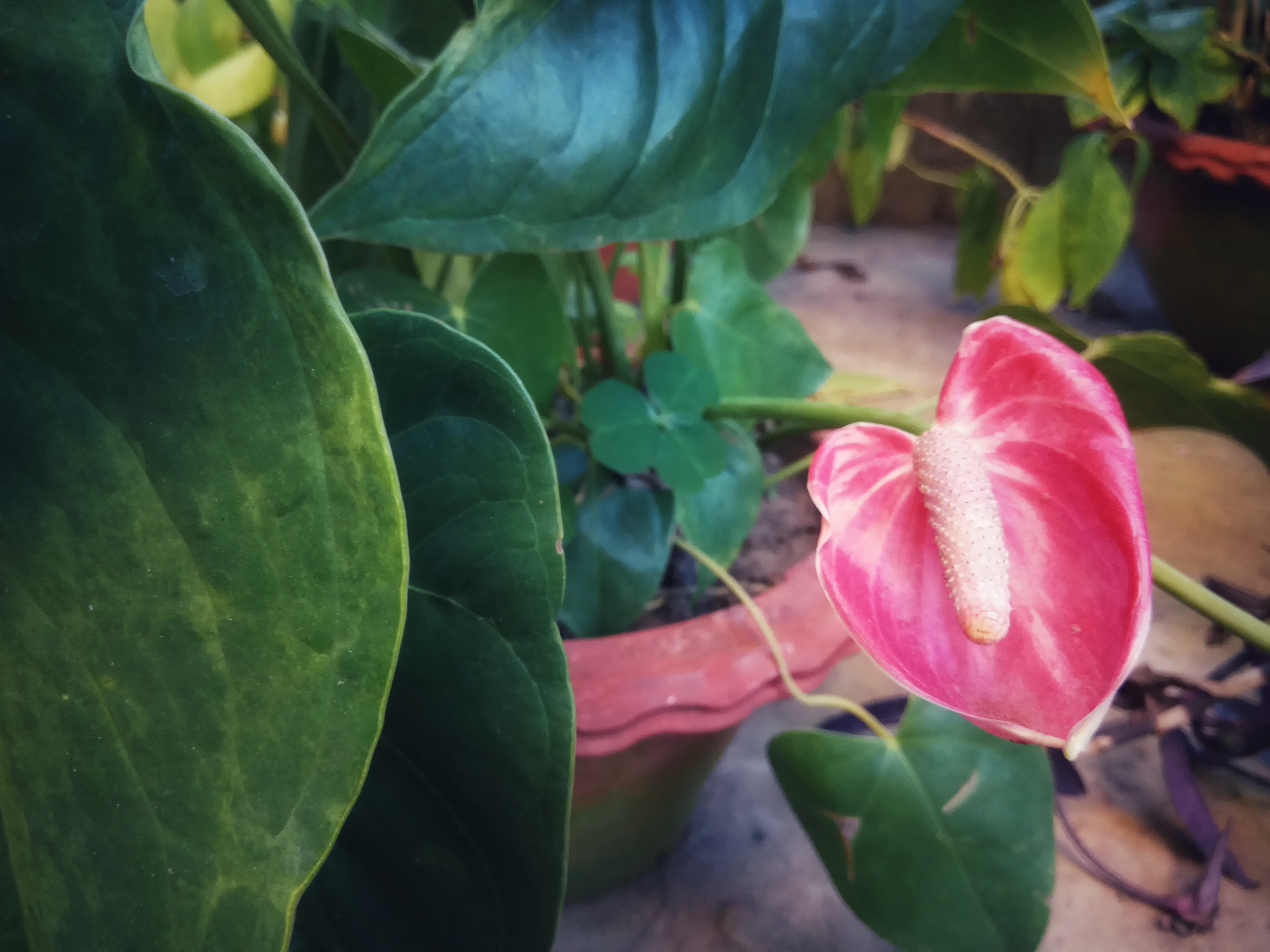
It is worth knowing what you are actually looking at. The showy red, pink, or white "flower" is a spathe, a modified waxy bract, and the true flowers are the tiny structures packed onto the finger-like spadix in the middle[5]. That bract construction is why anthurium blooms last for weeks rather than days — and why a well-lit plant can appear to be in continuous flower.

Two other factors gate blooming alongside light. Anthurium needs consistent warmth — ideally 65–80°F, never below about 55°F — and high humidity, above 60% where possible. A plant that is bright enough but cold or bone-dry in the air will still refuse to flower. And be patient after any move: a relocated anthurium typically takes 4–8 weeks to respond with new buds.
07 · GROW LIGHTS & SEASONS
Grow lights and seasonal light changes
If no window in your home offers bright indirect light, a grow light will restore blooming. Anthurium responds well to a full-spectrum LED run 10–12 hours a day, positioned 12–24 inches above the foliage — far enough that the light is diffuse rather than harsh[8][11]. Because anthurium needs moderate rather than intense light, a modest fixture is usually enough; there is no need for a high-output horticultural lamp.
Seasonally, the sensible move is to shift the plant closer to the window in autumn and winter and pull it back in spring. The winter sun is weak and low enough that a spot which was scorching in July may be perfect in January — and the reverse trap catches people every spring, when a plant that overwintered happily on a south sill suddenly burns. Rotate the pot a quarter turn each week so all sides get equal light and the plant grows symmetrically.
08 · LIGHT & WATERING
Match watering to your anthurium's light level
Light and water are two halves of the same equation, and anthurium is unforgiving when they are mismatched. In bright indirect light the plant transpires steadily and the mix dries in about a week; in a dim corner it may stay damp for a fortnight, and those epiphytic roots rot quickly in stagnant, airless soil. Fix the light and watering gets much easier — for the full schedule and method, see watering an anthurium: a complete guide to frequency and method.
ACQUATERRA
Bright light plus steady root-zone moisture is what keeps an anthurium in continuous bloom.
Shop AcquaTerra →To sum up the anthurium light requirements: bright, indirect light for 8–10 hours a day is what produces continuous blooms, medium light gives you a green plant with few flowers, and direct sun scorches leaves and fades spathes. Choose an east window or a filtered south window, keep the plant close to the glass, adjust with the seasons, and add a modest grow light if your rooms run dark. Related reading: watering an anthurium and how often to water an anthurium.
Frequently asked questions about anthurium light
How much light does an anthurium need?
Anthurium light requirements centre on bright, indirect light for 8–10 hours a day. That brightness is what triggers continuous blooming. It tolerates medium light but flowers poorly there, and direct sun scorches the leaves.
Why is my anthurium not blooming?
Almost always insufficient light. A plant producing leaves but no spathes needs a brighter position — move it beside an east window or 3–6 feet from a filtered south window and expect buds within 4–8 weeks.
Can an anthurium take direct sunlight?
No, apart from gentle early-morning sun. Direct midday or afternoon sun bleaches and scorches anthurium leaves within days and fades the spathes. Always filter bright windows with a sheer curtain.
Can an anthurium grow in low light?
It will survive, but it will not flower. In low light an anthurium makes small leaves slowly, stretches its stalks, and stops producing spathes. Low light also keeps the soil wet, raising the risk of root rot.
What window is best for an anthurium?
An east-facing window is ideal — soft morning sun plus bright indirect light all day. South and west windows work well if filtered with a sheer or the plant is set back; north windows are safe but usually too dim for blooms.
Why are my anthurium leaves turning brown at the edges?
Usually too much direct light combined with low humidity, which dries the leaf margins faster than the roots can resupply. Move the plant out of direct sun, raise humidity above 60%, and keep moisture steady.
Do anthuriums need a grow light?
Only if no window offers bright indirect light. A modest full-spectrum LED run 10–12 hours a day, 12–24 inches above the plant, easily meets anthurium light needs and restores blooming in a dim room.
References
- [1] Missouri Botanical Garden. (n.d.). Anthurium andraeanum — Plant Finder. missouribotanicalgarden.org.
- [2] Royal Horticultural Society. (n.d.). Anthurium / RHS Gardening. rhs.org.uk.
- [3] Clemson Cooperative Extension. (n.d.). Indoor plants — light requirements. Home & Garden Information Center. hgic.clemson.edu.
- [4] University of Florida IFAS Extension. (n.d.). Anthurium production and care. edis.ifas.ufl.edu.
- [5] Royal Botanic Gardens, Kew. (n.d.). Anthurium andraeanum Linden ex André. Plants of the World Online. powo.science.kew.org.
- [6] USDA, Agricultural Research Service. (2023). GRIN: Anthurium andraeanum. npgsweb.ars-grin.gov.
- [7] North Carolina State Extension. (n.d.). Anthurium andraeanum. plants.ces.ncsu.edu.
- [8] University of Minnesota Extension. (2022). Lighting for indoor plants and starting seeds. extension.umn.edu.
- [9] Penn State Extension. (2020). Houseplants: Light requirements. extension.psu.edu.
- [10] University of Wisconsin–Madison Division of Extension. (n.d.). Anthurium, Anthurium andraeanum. hort.extension.wisc.edu.
- [11] Michigan State University Extension. (n.d.). Light and houseplants. canr.msu.edu.
- [12] Taiz, L., & Zeiger, E. (2010). Plant Physiology, 5th ed. Sinauer Associates.
- [13] Lambers, H., Chapin, F.S., & Pons, T.L. (2008). Plant Physiological Ecology, 2nd ed. Springer.
- [14] ASPCA. (n.d.). Flamingo flower (Anthurium) — toxic to dogs, cats, and horses. aspca.org.
- [15] Croat, T.B. (1988). Ecology and life forms of Araceae. Aroideana, 11, 4–55.