

How to Install an Olla in a Raised Bed, Pot, or Garden
An olla installs the same basic way in any soil — dig, place, backfill, fill — but raised beds, containers, and in-ground gardens each have variations worth knowing. Raised beds may be shallower than the olla and require digging into the underlying ground. Large pots need clearance considerations. In-ground gardens need to account for root competition from existing plants. This guide covers all three install scenarios.
THE SHORT VERSION
01 · THE COMMON STEPS
What every olla install has in common
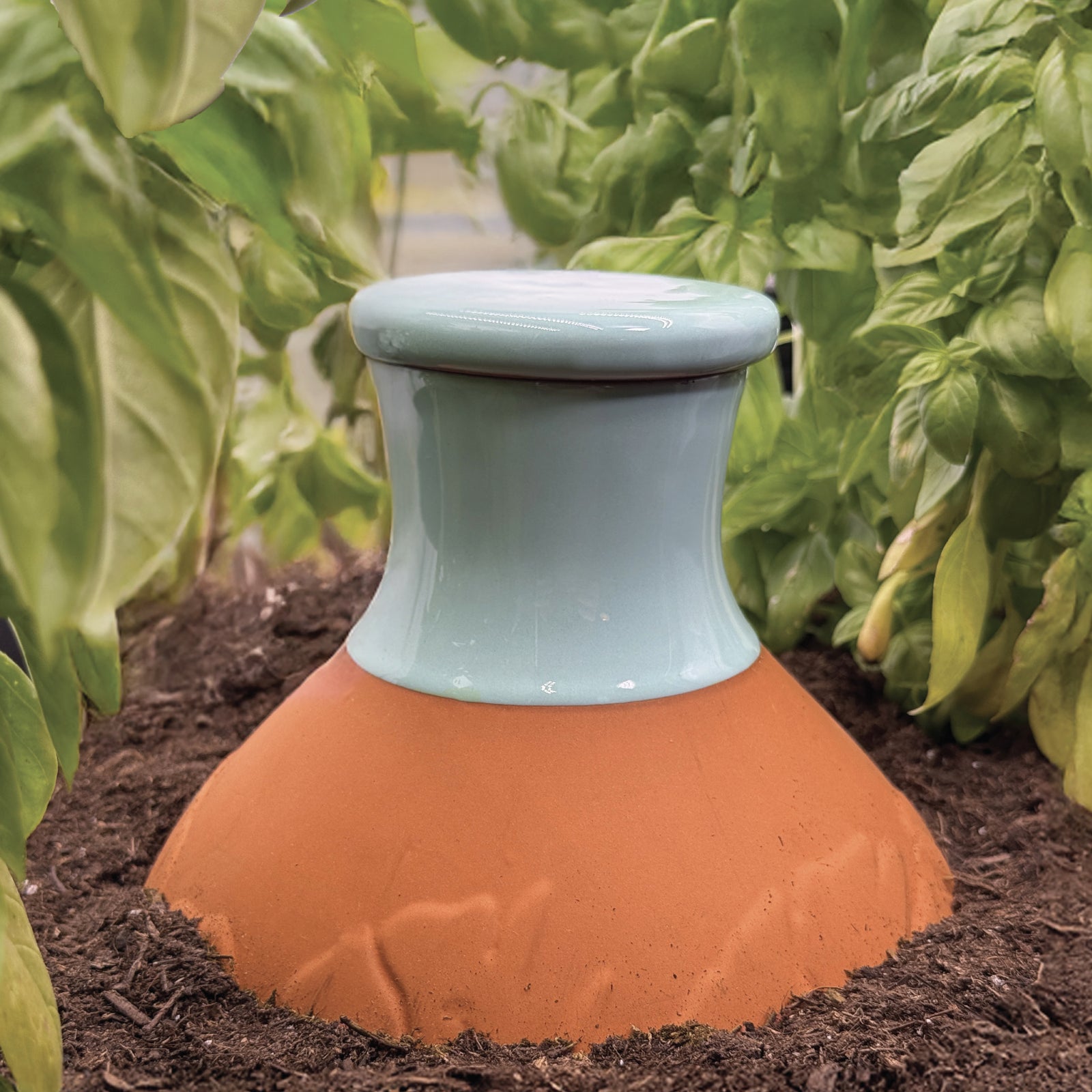
Every olla installation starts with the same five steps regardless of the setting. Pre-soak the olla in water for 15–30 minutes to prime the clay. Dig a hole large enough to hold the olla up to its neck with about 2 inches of clearance on each side. Place the olla and confirm the lid sits 1–2 cm above the soil surface. Backfill firmly with soil tamped in layers to ensure direct clay-to-soil contact. Fill the reservoir through the top opening and replace the lid.
From there, the scenario determines the small adjustments. For step-by-step setup mechanics, see the olla watering system step-by-step setup guide. For depth specifications, see how deep to bury an olla.
02 · RAISED BEDS
Installing an olla in a raised bed
Most home raised beds are 12–18 inches deep — tall enough to accommodate a 1.25-gallon Acqua Olla’s 14–15 inch height. Standard install applies: dig the hole, place the pot, backfill. The only adjustment for raised beds is checking that the bed sits on permeable ground. If your raised bed has a solid bottom (like a deck-mounted planter or a bed with weed barrier underneath), the olla can’t drain or release water beneath the bed bottom — not catastrophic, but reduces the depth-direction reach of the wetted zone.
For shallow raised beds (under 12 inches deep), dig down through the bed bottom into the underlying soil. Most raised beds sit on permeable ground so this works fine. The olla extends below the bed frame, which is perfectly acceptable. For full raised-bed strategy, see using ollas in raised beds — complete setup guide.
03 · LARGE CONTAINERS
Installing an olla in a large pot
Ollas work in containers 16+ inches across with enough soil depth to hold the pot. A 1.25-gallon Acqua Olla in a 16-inch container takes up substantial soil volume — about 25–30% of the container’s capacity. Plan accordingly. For containers 12–16 inches across, a smaller 0.5-gallon olla is a better fit; below 12 inches, a self-watering spike like the AcquaTerra is more practical — see the best self-watering spikes for indoor plants.
01 · Raised bed
Standard install
Most common. Bed depth usually fits the olla. Dig through bed bottom if shallow. The Acqua Olla covers a typical 4×4 bed.
02 · Large container
16+ inch pots
Olla takes 25–30% of soil volume. For smaller containers, use a self-watering spike instead.
03 · In-ground patch
Most flexible
No bed boundary. Watch for existing root competition; move olla slightly to avoid cutting major roots.
04 · Solid-bottom planter
Limited reach
Olla works but the wetted zone doesn’t extend below the bed bottom. Slightly reduced coverage.
Container installation follows the same five steps. The wetted zone fills most of the container, so plant placement is less critical — any plant in the container will receive water. For container-specific guidance, see best ollas for container gardening.
04 · IN-GROUND GARDENS
Installing an olla in an in-ground patch
In-ground installations are the most flexible because there’s no bed boundary to work around. Dig to depth, place the pot, backfill. The main consideration is existing root competition — established perennials and trees may have roots that resist being cut. If you hit a major root during digging, move the olla a foot in another direction rather than severing the root.
In-ground gardens also benefit from slight depth additions. Burying the olla an inch deeper than usual lets surrounding soil shield the clay from temperature swings, which extends pot life. For lifespan strategy, see how long olla pots last.
01 · Pre-soak the olla
Submerge for 15–30 minutes to prime the clay. Skip this step and the first fill won’t release water effectively.
02 · Dig the hole
Hole height = olla height minus 1–2 cm (for lid clearance). Width: 2 inches wider than the olla per side.
03 · Test fit
Lower the olla in and check that the lid sits 1–2 cm above the soil surface. Adjust depth if needed.
04 · Backfill in layers
Add 3–4 inches of soil at a time, tamping firmly. Air gaps disrupt release; layered backfill packs more tightly.
05 · Fill and seal
Pour water through the top opening to within an inch of the rim. Replace the lid firmly.
Verification
Check reservoir level dropped 1–3 inches in the first 24 hours. That confirms the clay is releasing properly.
05 · AVOIDING INSTALL MISTAKES
Common installation mistakes
First mistake: skipping the pre-soak. Dry clay absorbs water inward before releasing outward; without pre-soaking, the first fill takes 24–48 hours to start delivering water. Second mistake: loose backfill. Air gaps disrupt the capillary connection that drives water release. Third mistake: lid buried under soil or mulch. Refilling becomes a chore and the system gets neglected.
Fix all three by pre-soaking, backfilling firmly in layers, and keeping the lid 1–2 cm above soil. Five minutes of care during install saves months of poor performance.
- Pre-soak the olla before burial. Submerge the porous clay in water for 15–30 minutes to prime the wall and prevent dry-clay shock when filled, so the system reaches steady release faster.
- Mulch over the soil surface. A 2–3 inch layer of mulch around (not on top of) the olla slows surface evaporation, which keeps more of the olla’s water reaching the roots.
- Check the lid is sealed. An open or loose lid lets mosquitoes breed and accelerates evaporation through the reservoir opening. Make sure the lid sits flush every time you refill.
- Keep the neck above the soil. The olla’s narrow neck and lid should stay 1–2 cm above the soil surface, so you can refill without digging and so the lid keeps debris out.
- Refill before the reservoir empties. Run an olla dry repeatedly and the porous wall can develop hairline cracks. Top up while there’s still water visible inside.
06 · POST-INSTALL CHECKS
How to verify the install worked
Two checks within the first 24 hours: visually confirm the reservoir water level dropped 1–3 inches (proves clay is releasing) and check soil moisture 6 inches from the olla wall (should be lightly moist). A week later, check moisture at 12, 15, and 18 inches from the olla — soil should be moist at all three distances. If any check fails, see the troubleshooting steps in olla troubleshooting — why isn't my olla working.
Successful installs are quiet — the system works without further attention. If you find yourself fussing with the olla weekly, something is wrong with the install rather than the system. Most issues trace back to insufficient pre-soak or loose backfill.

Olla installation is straightforward across all three scenarios — raised beds, large containers, in-ground gardens. The five-step process (pre-soak, dig, place, backfill, fill) is identical; the adjustments are minor. For full setup mechanics, see the olla watering system step-by-step setup guide. For spacing decisions, see olla spacing — how far apart to place ollas.
FAQ · COMMON QUESTIONS
Frequently Asked Questions
How do you install an olla in a raised bed?
Pre-soak the olla, dig a hole the height of the pot (digging through the bed bottom if the bed is too shallow), place the olla so only the lid sits above soil, backfill firmly in layers, and fill the reservoir. Total time about 15 minutes. Full details in using ollas in raised beds — complete setup guide.
Can you install an olla in a pot or container?
Yes, in containers 16+ inches across with enough depth to hold the olla. The pot takes 25–30% of the soil volume so plan plant placement accordingly. For smaller containers (under 12 inches across), a self-watering spike is a better fit than an olla. See best ollas for container gardening.
Do you need to dig through the bottom of a raised bed?
Only if the bed is shallower than the olla’s height (under 12 inches deep for an Acqua Olla). Most raised beds sit on permeable ground, so the olla can extend below the bed frame without issue.
How long does an olla installation take?
About 15 minutes per olla once you have everything ready, including the pre-soak time. The pre-soak runs in the background while you prepare the hole, so the active installation is closer to 10 minutes.
What if I hit roots while digging?
Move the olla a foot in another direction rather than cutting major roots. Established perennial and tree roots resist installation and may damage the olla over time as they grow against the clay wall.
Can I install an olla in clay soil?
Yes — clay soils actually work well for olla irrigation because they hold moisture broadly. The wetted zone extends slightly farther than in loam, which can let you space ollas a bit looser. Avoid waterlogged conditions; the olla won’t release water into already-saturated soil.
Should I add anything to the soil during install?
Compost added to the backfill soil improves moisture retention around the olla, which extends the wetted zone. Avoid adding fertilizer directly around the olla — concentrated nutrients can clog the clay’s porosity over time. For long-term clay care, see how to clean and maintain your olla pot.
What if my install isn’t working?
Check three things: did you pre-soak the olla (dry clay won’t release immediately), is the backfill firmly tamped (air gaps stop water flow), and is the lid sealed (open lid evaporates the reservoir). Full troubleshooting is in olla troubleshooting — why isn't my olla working.
References
01 Bainbridge, D. A. (2001). “Buried clay pot irrigation: a little known but very efficient traditional method of irrigation.” Agricultural Water Management, 48(2), 79–88. DOI: 10.1016/S0378-3774(00)00119-0
02 Food and Agriculture Organization (FAO). “Pitcher irrigation: A simple, low-cost irrigation technique.” FAO Agricultural Technology Series. fao.org