

Olla Spacing Guide: How Far Apart to Place Ollas
How far apart you place ollas determines whether your garden gets even coverage or leaves dry pockets between pots. Too close and you’re spending more than necessary; too far and plants in the gaps suffer. The right spacing for most home gardens is 3–4 feet between olla centers — tight enough that the wetted zones touch or slightly overlap, loose enough to avoid waste. This guide covers spacing by olla size, plant type, and soil conditions.
THE SHORT VERSION
01 · THE PRINCIPLE
Why spacing matters
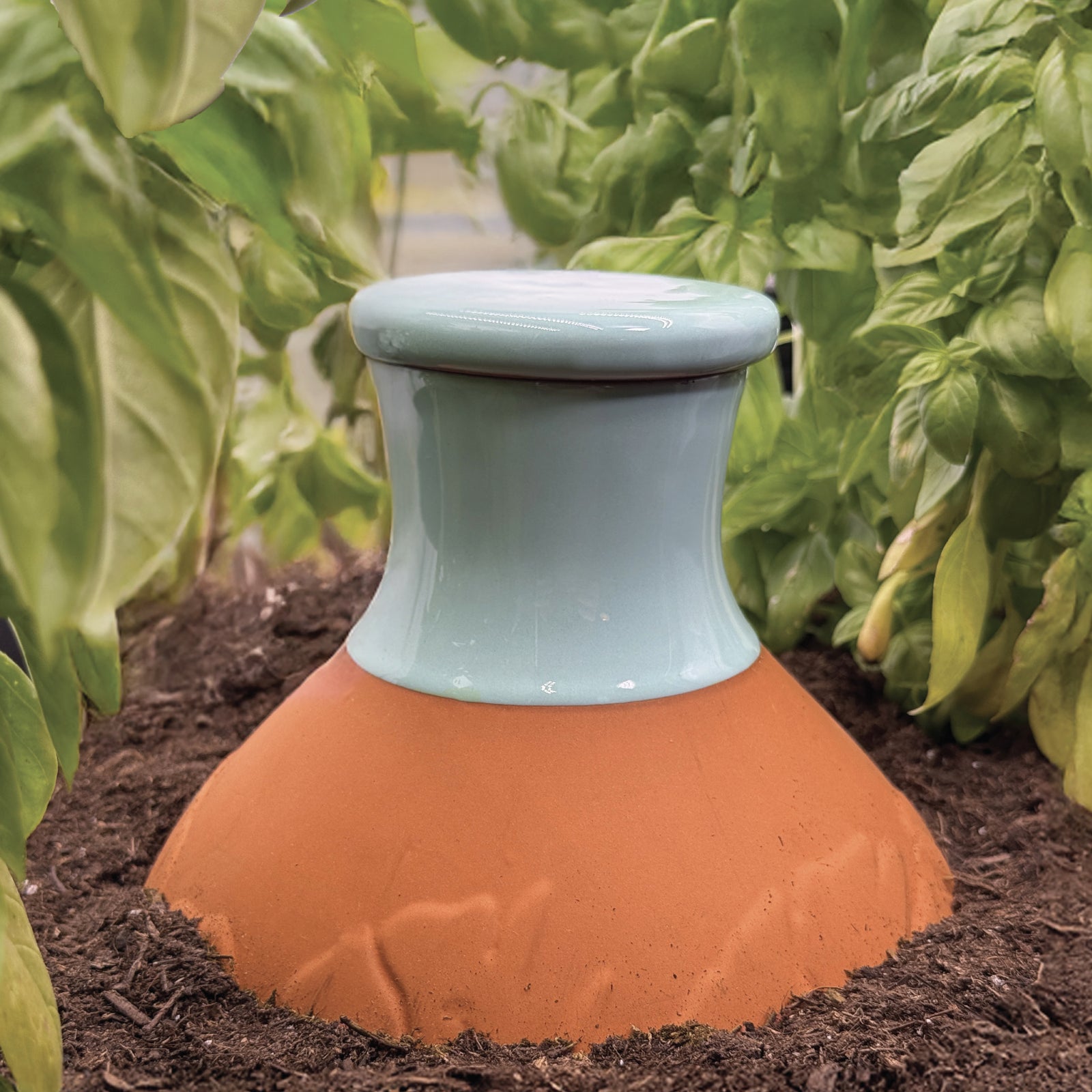
Each olla has a wetted zone — a roughly circular area of moist soil around the buried pot. For a 1.25-gallon Acqua Olla in average soil, that zone reaches 15–20 inches outward, creating a circle about 2.5–3 feet across. If you place two ollas farther apart than 4 feet, you leave a dry strip in between where plant roots can’t reach moisture. Place them closer than 2 feet and the zones overlap significantly — wasted reservoir capacity in the same patch of soil.
The 3–4 foot range is the sweet spot. The zones touch lightly at the edges, ensuring every square foot of soil is within reach of at least one olla. For underlying coverage math, see how many ollas per square foot.
02 · SPACING BY SIZE
Distance ranges by olla volume
Small 0.5-gallon ollas have smaller wetted zones (about 10–14 inches outward) and need closer spacing: 2–3 feet between centers. Medium 1-gallon ollas reach 12–15 inches outward and pair well at 3-foot spacing. A 1.25-gallon Acqua Olla reaches 15–20 inches outward, so 3–4 foot spacing covers the gaps. Very large 2-gallon ollas extend to 22–25 inches and can space at 4–5 feet.
These ranges assume average loam soil. Adjust for soil type as covered below. For full coverage math, see how many ollas per square foot.
03 · SOIL ADJUSTMENTS
How soil type changes spacing
Clay soils hold moisture broadly, so the wetted zone extends farther from each olla — you can space slightly looser, maybe 4 feet for an Acqua Olla. Loam and most garden soils: standard 3–4 foot spacing works. Sandy soils drain vertically faster than they spread laterally, shrinking the wetted zone — tighten spacing to 2–3 feet. Very sandy soils may require ollas every 2 feet or alternative irrigation entirely.
01 · Small (0.5 gal)
2–3 ft apart
Smaller wetted zone means tighter spacing. Best for container gardens or dense planting.
02 · Medium (1 gal)
3 ft apart
Standard 1-gallon ollas in average soil. Most home-bed spacing falls here.
03 · Acqua Olla (1.25 gal)
3–4 ft apart
Designed in California for typical home garden bed spacing. One Acqua Olla per 4×4 patch.
04 · Large (2 gal+)
4–5 ft apart
Wider wetted zones support larger spacing. Less common at home garden scale.
If you’re unsure of your soil’s drainage, dig a small test hole, fill with water, and observe. Water that drains within 15 minutes indicates sand-dominant soil; water that pools for over an hour indicates clay-dominant. Loam falls between.
04 · RECTANGULAR BEDS
Spacing layouts for common bed shapes
4×4 raised bed: one Acqua Olla in the center. The 15–20 inch wetted radius reaches each edge of the bed. 4×8 raised bed: two Acqua Ollas spaced 4 feet apart along the long axis, each centered in its 4×4 sub-section. 4×12 raised bed: three Acqua Ollas at 4-foot intervals. 8×8 raised bed: four Acqua Ollas in a 2×2 grid at 4-foot spacing.
For irregular shapes, treat the bed as multiple 4×4 patches and place one olla per patch. The wetted zones will cover the spaces between patches. For raised-bed specifics, see using ollas in raised beds — complete setup guide.
01 · Measure the bed
Note the bed dimensions and shape. Rectangular beds space ollas along the long axis; square beds use a grid.
02 · Pick olla size
Acqua Olla (1.25 gal) is standard for home raised beds. Sizing decisions are in how many ollas per square foot.
03 · Mark positions
Use stakes, chalk, or marking paint to mark each olla position on the bed surface before digging.
04 · Check spacing
Confirm 3–4 feet between centers and that no plant position is more than 18 inches from an olla.
05 · Adjust for obstacles
Move ollas slightly to avoid existing roots, fixtures, or planned permanent structures. Keep spacing under 4 feet.
Soil tip
Sandy soils need tighter spacing; clay allows looser. Test your soil drainage before finalizing the layout.
05 · IN-GROUND GARDENS
Spacing for in-ground patches
In-ground gardens follow the same spacing principles but typically allow looser placement because the surrounding soil acts as a moisture buffer. For a 10×10 in-ground vegetable patch, plan a 2×2 grid of ollas at 4–5 foot spacing. The slightly larger gaps work because in-ground beds have deeper soil reserves that hold residual moisture between waterings.
For larger market-garden-scale plots, ollas at 5-foot spacing in a grid work well for raised vegetable plantings. Trees and perennials with deeper roots can space farther — 6–8 feet between ollas serving established fruit trees.
- Sketch the layout before digging. Plot olla positions on paper or in a garden app. Mark each plant location relative to its nearest olla.
- Verify each plant is within 18 inches of an olla. Plants outside the wetted zone won’t receive water. Adjust layouts if needed.
- Account for soil drainage. Sandy soils tighten spacing by 30%; clay soils loosen it by 10–20%. Test your drainage before committing to a layout.
- Plan for olla access. Each olla needs a clear path to its lid for weekly refills. Don’t bury one under permanent structures.
- Verify with soil moisture test. After a week of operation, check soil moisture at the midpoint between ollas. Wet midpoints confirm spacing is correct.
06 · SPACING MISTAKES
Common spacing errors to avoid
Most common mistake: spacing ollas too far apart on the assumption that the wetted zone reaches farther than it does. The result is dry gaps where plants suffer. Second mistake: clustering ollas too close together in one spot (often because gardeners want all the “watering” in one area). This wastes capacity and leaves the rest of the bed unsupported. Third mistake: ignoring soil type. Sand vs clay can shift correct spacing by 30% or more.
Fix is simple: lay out spacing on the bed surface before digging, marking olla positions with stakes or paint. Check that plant placement falls within 18 inches of an olla center for every plant. For installation details, see the olla watering system step-by-step setup guide.
Olla spacing is one of the few measurements that’s worth getting right the first time — moving a buried olla is more work than installing it. Three to four feet between Acqua Ollas, tighter for sandy soils, slightly looser for clay. The wetted zones should touch lightly with no dry pockets. For full coverage math, see how many ollas per square foot.
FAQ · COMMON QUESTIONS
Frequently Asked Questions
How far apart should ollas be placed?
Three to four feet between centers for 1.25-gallon Acqua Ollas. Smaller 0.5-gallon ollas need 2–3 foot spacing. The wetted zones should touch or lightly overlap to ensure no dry gaps between pots.
Can ollas be placed too close together?
Yes — placing ollas closer than 2 feet apart wastes reservoir capacity by overlapping the wetted zones significantly. The same soil gets watered twice while other areas of the bed go dry. Spread them out to standard spacing.
How many ollas fit in a 4x8 raised bed?
Two 1.25-gallon Acqua Ollas spaced 4 feet apart along the long axis of the bed. Each olla centers in its 4×4 sub-section and covers the plants within that zone.
Should olla spacing change for tomatoes vs herbs?
Slightly. Thirsty plants like tomatoes pull water aggressively and shrink the practical wetted zone, so tighten spacing to 3 feet. Drought-tolerant herbs let you stretch to 4 feet. Mixed plantings should follow the spacing for the thirstiest plant in the group.
Does spacing change in sandy soil?
Yes — sandy soils drain fast and shrink the lateral spread of water from each olla. Tighten spacing to 2–3 feet between centers in very sandy soil. For clay-dominant soils, you can loosen to 4 feet.
Can I add ollas to an existing garden?
Yes — install ollas in the largest gaps between existing plants. Aim for 3–4 foot spacing from any neighboring ollas and within 12–18 inches of each plant you want to water. Existing root systems may need a season to grow into the new wetted zones.
What if I have an oddly shaped bed?
Treat irregular shapes as combinations of 4×4 patches and place one olla per patch. The wetted zones cover the spaces between patches naturally. L-shaped, triangular, and curved beds all work with this approach.
Can wetted zones overlap?
Light overlap is fine and actually desirable for ensuring full coverage. Heavy overlap (zones substantially inside each other) wastes reservoir capacity. Aim for the edges of adjacent zones to just touch or slightly overlap.
References
01 Bainbridge, D. A. (2001). “Buried clay pot irrigation: a little known but very efficient traditional method of irrigation.” Agricultural Water Management, 48(2), 79–88. DOI: 10.1016/S0378-3774(00)00119-0
02 Food and Agriculture Organization (FAO). “Pitcher irrigation: A simple, low-cost irrigation technique.” FAO Agricultural Technology Series. fao.org