

How Often to Water a Kalanchoe: Schedule, Signs, and Factors That Matter
Kalanchoe (Kalanchoe blossfeldiana, the florist's flaming Katy) is a succulent, and almost everything that goes wrong with one comes down to watering it like it is not[1][2]. Those thick, glossy, scallop-edged leaves are water tanks; the roots are fine, shallow, and rot within days in soggy soil. Overwatering is the single biggest killer of kalanchoe by a wide margin. This guide covers how often to water a kalanchoe through the year, the soak-and-dry method that suits it, the variables that genuinely move the schedule, and how to tell thirst from rot before it is too late.
Water a kalanchoe roughly every 2–3 weeks in the growing season, and only when the soil is dry all the way through — not just at the surface. Soak thoroughly until water runs from the drainage holes, then let the pot dry out completely before watering again. In winter, stretch that to every 3–5 weeks or longer. When in doubt, wait: kalanchoe recovers easily from drought and rarely recovers from root rot.
01 · THE SIMPLE ANSWER
How often to water a kalanchoe
In typical indoor conditions a kalanchoe needs water about every 2–3 weeks during spring and summer, and considerably less in winter — often only every 3–5 weeks[1][3]. Those numbers are a starting point, not a rule. The real instruction is simpler: water only when the potting mix has dried out completely, then soak it properly.
Test it properly before you water. Push a finger two inches into the soil, or lift the pot — a dry kalanchoe pot feels startlingly light compared with a freshly watered one, and weight is the most reliable gauge for any succulent. A wooden skewer pushed to the bottom of the pot and pulled out clean and dry is the third check. Damp at depth means wait, even if the surface looks parched.
Because kalanchoe stores water in its leaves, it tolerates a missed watering with no lasting harm at all. It does not tolerate a wet pot. If you are unsure, the correct answer is always to wait a few more days — a thirsty kalanchoe plumps back up within a day of a soak, while a rotted one usually cannot be saved.
02 · THE BOTANY
Why a kalanchoe needs so little water
Kalanchoe blossfeldiana is a succulent in the stonecrop family (Crassulaceae), native to the seasonally dry highlands of Madagascar, where it grows on rocky, fast-draining ground under strong sun with long dry periods between rains[4][5]. Every part of the plant is adapted to that climate: thick water-storing leaves, a waxy cuticle that limits evaporation, and a compact root system that expects to sit in gritty, airy soil rather than dense wet compost.
Like most Crassulaceae, kalanchoe uses CAM photosynthesis — crassulacean acid metabolism, named for this very plant family. It keeps its stomata closed through the hot day and opens them at night to take in carbon dioxide, storing it as an acid until daylight[6]. The result is dramatically lower water loss than an ordinary foliage plant of the same size, which is exactly why a kalanchoe drinks so much less than a fern or a coleus next to it on the same shelf.
That efficiency is also the trap. Because the plant uses water slowly, soil stays wet far longer than the owner expects, and the fine roots suffocate. Waterlogged mix drives out oxygen and opens the door to Pythium, Phytophthora, and stem-rot fungi, which move up into the crown quickly once established[7]. There is no rescuing a collapsed crown; the only reliable save is taking healthy leaf or stem cuttings, which root very easily.

One safety note that shapes where you put the plant: kalanchoe contains cardiac glycosides (bufadienolides) and is listed by the ASPCA as toxic to dogs, cats, and horses, causing gastrointestinal upset and, in larger ingestions, abnormal heart rhythm[8]. Keep it well out of reach of pets and children.
03 · SEASONAL SCHEDULE
Kalanchoe watering schedule by season
Kalanchoe growth tracks light and temperature closely: active from spring into autumn, nearly idle in the dark months. Water use follows the same curve, so the same pot that needs a drink every two weeks in July can go over a month in January[3][9].
01 · Spring (Mar–May)
Every 2–3 weeks
Growth restarts as light returns. Resume normal soak-and-dry watering and begin a dilute feed once a month.
02 · Summer (Jun–Aug)
Every 2 weeks
Peak demand. Small terracotta pots in a hot sunny window may dry in 10 days; plants outdoors dry faster still.
03 · Fall (Sep–Nov)
Every 3 weeks
Taper as light drops. Stop feeding. This is when long nights start setting flower buds for a winter bloom.
04 · Winter (Dec–Feb)
Every 3–5 weeks
Minimum water. Cool, dim, and barely growing — this is when most kalanchoes are killed by overwatering.
Treat those intervals as a prompt to check the pot, never as an instruction to pour. A kalanchoe in a large plastic pot in a north-facing room may still be wet at five weeks, while a small terracotta pot on a sunny sill in August can be dry in ten days.
04 · FACTORS THAT MATTER
Six factors that change how often you water a kalanchoe
Light level: The biggest variable of all. A kalanchoe in a south window with hours of direct sun photosynthesises hard and dries its pot in two weeks; the same plant in a dim corner can stay damp for a month or more. Fix the light first and the watering becomes far easier — see kalanchoe light requirements.
Pot size and material: Unglazed terracotta breathes and pulls moisture out through its walls, which suits a rot-prone succulent perfectly. Plastic and glazed ceramic hold water far longer. An oversized pot is a genuine hazard: excess soil around a small rootball stays wet for weeks. Size up only one pot at a time, and never use a pot without drainage holes.
Soil mix: Standard peat-based houseplant compost holds too much water for kalanchoe. Use a cactus and succulent mix, or cut ordinary potting mix with 30–50% perlite, pumice, or coarse grit. Free drainage does more to prevent root rot than any watering schedule[10].
Season and dormancy: Winter roughly halves water demand. Cool temperatures, short days, and near-zero growth mean a pot can hold moisture for a month. Watering a dormant kalanchoe on a summer schedule is the most common way it dies.
Temperature and humidity: Kalanchoe likes warmth, ideally 60–75°F, and dislikes anything below about 50°F. Warm, dry, well-ventilated air dries a pot quickly; a cool, humid, still room keeps it wet. Dry indoor air is no problem for this plant — unlike most houseplants it needs no misting, and wet foliage in cool conditions invites fungal spotting.
Flowering and plant size: A kalanchoe in full bloom is working harder and dries a little faster than one resting between flushes, and a large, well-established plant transpires more than a young cutting. Neither changes the method — check the soil, then soak — but both shorten the interval slightly.

05 · UNDERWATERING SIGNS
Signs your kalanchoe needs water
Underwatering a kalanchoe is a slow, gentle, and almost entirely reversible problem — the plant simply draws down its leaf reserves and waits[9]:
- Soft, wrinkled, thinning leaves. The earliest reliable signal. Firm plump leaves lose their tension and start to crease as stored water is used up. A thorough soak refills them within a day or two.
- Dry, crisp lower leaves. The oldest leaves at the base shrivel and go papery brown first as the plant sacrifices them to protect new growth. Pull them off cleanly and water.
- Flowers fading fast or buds aborting. Prolonged drought during bloom shortens the display sharply and can make unopened buds dry up and drop.
- A very light pot and soil shrinking from the sides. Severely dry mix contracts and turns hydrophobic, so water runs down the gap and straight out the bottom. Bottom-soak the pot in a basin for 20–30 minutes to rehydrate the rootball properly.
None of these are emergencies. A kalanchoe can go a month past its usual interval and bounce back completely — which is why erring toward dry is always the safer error with this plant.
06 · OVERWATERING SIGNS
Signs you’ve overwatered your kalanchoe
Overwatering is the number one killer of kalanchoe, and it moves fast once rot takes hold. Learn these signs and act on the first one[7][11]:
- Yellow, translucent, mushy leaves. The defining sign. Overwatered kalanchoe leaves go soft and water-soaked rather than dry and crisp, and they squash between the fingers instead of snapping.
- Blackened, collapsing stem at the soil line. Crown and stem rot. The plant may topple or pull away from the roots entirely. Once the crown is soft the plant is lost — take cuttings from clean upper growth immediately.
- Wilting despite wet soil. The most misleading symptom of all. Rotted roots cannot take up water, so the plant looks thirsty while sitting in mud. Do not water more — unpot it and check the roots.
- Fungus gnats, mould, and a sour-smelling pot. Small flies around the soil, white surface mould, or a musty smell all mean the mix has been staying wet far too long between waterings.

If you catch it early, act at once: unpot the plant, shake off the wet mix, cut away every brown or mushy root with clean scissors, let the plant air-dry for a day, and repot into dry, gritty cactus mix — then leave it a week before the first light watering. For the full protocol, see how to stop overwatering houseplants. If the crown has already gone, take leaf or stem cuttings: kalanchoe roots readily and you can rebuild the plant in weeks.
07 · THE METHOD
How to actually water a kalanchoe
Use the soak and dry method. When the mix is dry through, water thoroughly and evenly until it runs freely from the drainage holes — roughly 1½–2 cups (350–500 ml) for a 6-inch pot. Half-hearted sips wet only the top inch, leaving the deeper roots dry and encouraging them to stay shallow[10].
Water the soil, not the plant. Pouring into the crown leaves moisture trapped between the tightly packed leaves and flower heads, which invites rot and botrytis. Aim the spout at the soil surface around the edge of the pot, or bottom-water by standing the pot in a shallow tray for 20–30 minutes and letting the mix wick moisture up.
Always empty the saucer or cache pot within 15 minutes. A kalanchoe left standing in run-off water is a kalanchoe with rotting roots — this single habit prevents most losses. Decorative outer pots with no drainage are the most common hidden cause.
Water in the morning so any splashes on the foliage dry through the day, and use room-temperature water rather than cold straight from the tap. Feed only during active growth, at half strength, roughly monthly from spring to late summer, and stop entirely in winter.
One habit worth building: check every pot, every time, before you pour. A kalanchoe on a fixed calendar is a kalanchoe waiting to rot — the schedule tells you when to look, and the soil tells you what to do.
08 · TEMPERAMENT & QUICK FACTS
What a kalanchoe is really like
Origin. Kalanchoe blossfeldiana is a succulent in the stonecrop family (Crassulaceae) from the seasonally dry highlands of Madagascar, introduced to European horticulture in the 1930s and now one of the best-selling flowering pot plants in the world[4][12]. It is hardy only to about 50°F, so outside USDA zones 10–12 it lives indoors or summers on a patio and comes in before frost.
Personality. Kalanchoe is undemanding to the point of stubbornness. It asks for a sunny window, a gritty pot, and to be left alone between soaks — and it punishes attention far more than neglect. Its one genuine quirk is photoperiodism: it is a short-day plant that sets flower buds only after about six weeks of long, uninterrupted nights, which is why a supermarket plant blooms gloriously once and then sulks in a lamplit living room. Give it 14 hours of true darkness a night and it will flower again. Propagation is almost comically easy: leaf and stem cuttings root in gritty mix within a few weeks.
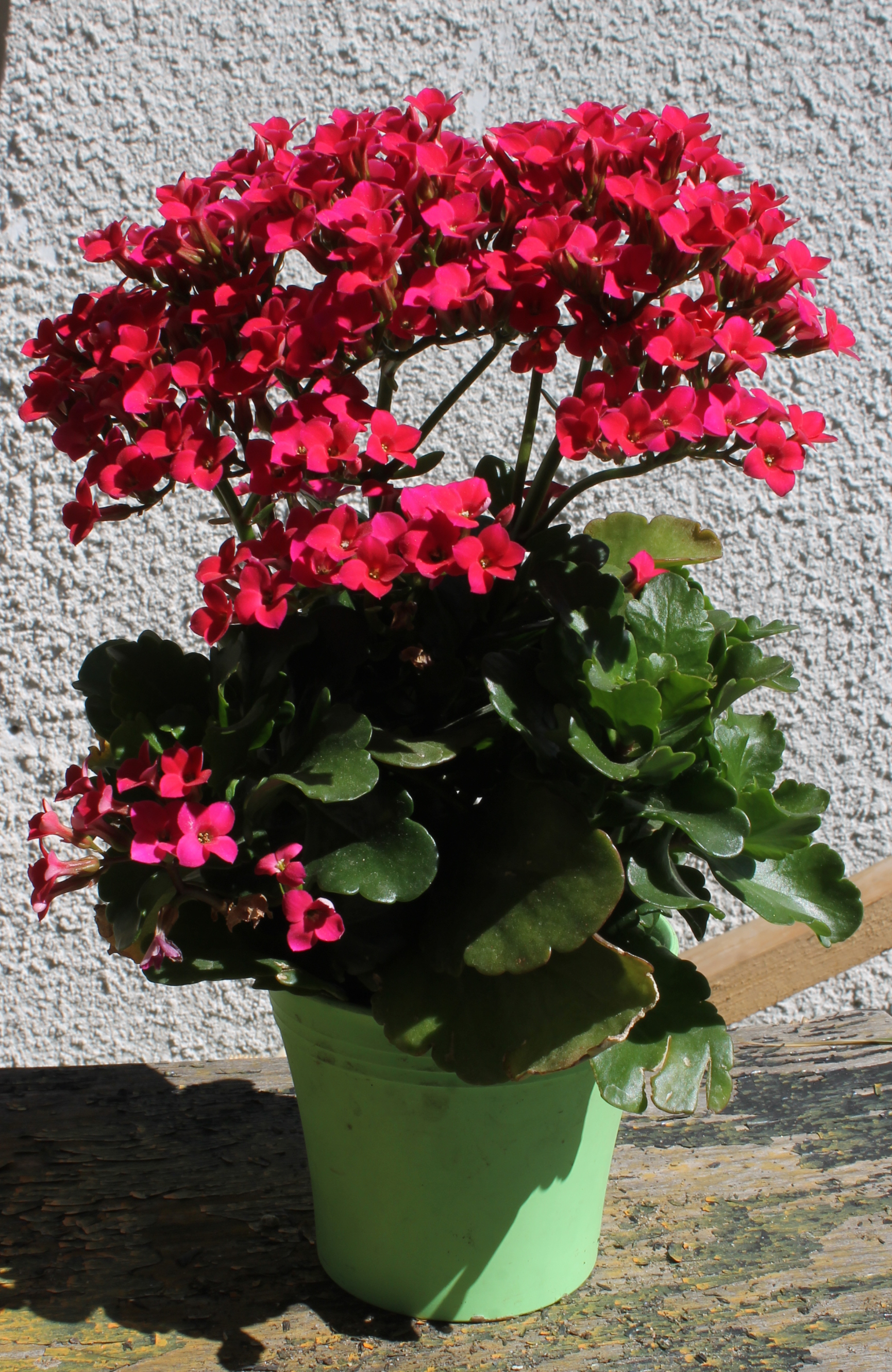
Size and habit. Expect a compact, bushy plant 8–18 inches tall and about as wide, with thick, glossy, scallop-edged leaves and dense clusters of small four-petalled flowers in red, pink, orange, yellow, or white that hold for six to eight weeks. In good light it stays low and dense; in poor light it stretches into a leggy, floppy plant that needs cutting back hard.
Toxicity. All parts contain cardiac glycosides (bufadienolides), and the ASPCA lists kalanchoe as toxic to dogs, cats, and horses — ingestion causes vomiting and diarrhoea, and larger quantities can affect heart rhythm[8]. Site it on a high shelf or sunny sill well out of reach of pets and small children, and wash your hands after pruning.
One practical upside of all this: because the interval is measured in weeks rather than days, a kalanchoe is the ideal plant to leave when you travel. For a dedicated plan, see how to water a kalanchoe while away.
ACQUATERRA
Slow, measured terracotta release — moisture without the soggy pot that rots a kalanchoe.
Shop AcquaTerra →Kalanchoe rewards restraint. Water roughly every 2–3 weeks in the growing season and every 3–5 weeks in winter, always checking that the mix is dry all the way through first, then soak it thoroughly and empty the saucer. Give it gritty soil, a pot with drainage, and the sunniest window you have, and it will bloom for weeks on almost no attention. For light, see kalanchoe light requirements; for travel, see how to water a kalanchoe while away.
Frequently asked questions
How often should I water a kalanchoe?
About every 2–3 weeks in spring and summer, and every 3–5 weeks in winter. Always check first: water only when the potting mix is dry all the way through, then soak thoroughly until it drains.
How much water does a kalanchoe need?
Roughly 1½–2 cups (350–500 ml) for a 6-inch pot — enough to run freely from the drainage holes. Deep, infrequent soaks are far better than frequent small sips.
What does an overwatered kalanchoe look like?
Yellow, translucent, mushy leaves, a blackened collapsing stem at the soil line, wilting despite wet soil, and fungus gnats. Overwatering is the number one killer of kalanchoe — unpot, trim rotted roots, and repot into dry gritty mix.
Why are my kalanchoe leaves wrinkled and soft?
If the soil is dry, that is thirst — the plant is drawing on stored leaf water, and a good soak plumps it back up in a day or two. If the soil is wet, it is root rot, and more water will make it worse.
How often to water a kalanchoe in winter?
Every 3–5 weeks, sometimes longer in a cool, dim room. Growth is minimal, so water demand collapses. Winter overwatering is the most common way kalanchoes are lost.
Should I mist a kalanchoe?
No. Kalanchoe is a succulent that tolerates dry indoor air well, and water sitting on the leaves or in the crown encourages fungal spotting and rot. Water the soil only.
Is kalanchoe toxic to pets?
Yes. Kalanchoe contains cardiac glycosides and is listed by the ASPCA as toxic to dogs, cats, and horses. Ingestion causes vomiting and diarrhoea, and large amounts can affect heart rhythm. Keep it out of reach.
References
- [1] Missouri Botanical Garden. (n.d.). Kalanchoe blossfeldiana — Plant Finder. missouribotanicalgarden.org.
- [2] Royal Horticultural Society. (n.d.). Kalanchoe blossfeldiana / RHS Gardening. rhs.org.uk.
- [3] Clemson Cooperative Extension. (n.d.). Kalanchoe. Home & Garden Information Center. hgic.clemson.edu.
- [4] Royal Botanic Gardens, Kew. (n.d.). Kalanchoe blossfeldiana Poelln. Plants of the World Online. powo.science.kew.org.
- [5] USDA, Agricultural Research Service. (2023). GRIN: Kalanchoe blossfeldiana. npgsweb.ars-grin.gov.
- [6] Taiz, L., & Zeiger, E. (2010). Plant Physiology, 5th ed. Sinauer Associates.
- [7] Penn State Extension. (2020). Houseplant Care: Watering, Fertilizing, and Repotting. extension.psu.edu.
- [8] ASPCA. (n.d.). Kalanchoe — Toxic to dogs, cats, and horses. aspca.org.
- [9] University of Minnesota Extension. (2021). Watering houseplants. extension.umn.edu.
- [10] University of Florida IFAS Extension. (2021). Succulents and cacti indoors. gardeningsolutions.ifas.ufl.edu.
- [11] Michigan State University Extension. (n.d.). Overwatering and root rot in houseplants. canr.msu.edu.
- [12] North Carolina State Extension. (n.d.). Kalanchoe blossfeldiana. plants.ces.ncsu.edu.
- [13] University of Wisconsin–Madison Division of Extension. (n.d.). Kalanchoe, Kalanchoe blossfeldiana. hort.extension.wisc.edu.
- [14] Lambers, H., Chapin, F.S., & Pons, T.L. (2008). Plant Physiological Ecology, 2nd ed. Springer.
- [15] Missouri Botanical Garden. (n.d.). Watering succulents and cacti indoors. missouribotanicalgarden.org.