

How Many Ollas Do You Need Per Square Foot?
How many ollas you need depends on the reach of each pot’s wetted zone, the size of your garden bed, and how thirsty your plants are. Most home gardeners overcomplicate this. The honest rule of thumb is one 1.25-gallon Acqua Olla per 9–16 square feet — meaning a single olla covers a 3×3 to 4×4 foot patch comfortably. This guide gives you the full sizing chart by olla volume and plant type, plus how to test whether your spacing is working.
THE SHORT VERSION
01 · THE WETTED ZONE
Understanding the olla’s wetted zone
The “wetted zone” is the radius of moist soil around a buried olla. Water moves through the clay wall and saturates the immediately surrounding soil — how far it spreads depends on soil type, plant density, and the olla’s size. For a typical 1-gallon olla in loam soil, the wetted zone extends 12–18 inches outward in each direction, creating a roughly 2–3 foot diameter circle of moist soil. For a 1.25-gallon Acqua Olla, the radius is 15–20 inches.
Plants whose roots reach into this zone receive water; plants outside it don’t. The sizing question is essentially “how many of these wetted zones cover your garden bed?” For the underlying mechanism, see how ollas work — the science.
02 · THE SIZING CHART
Ollas per square foot by pot size
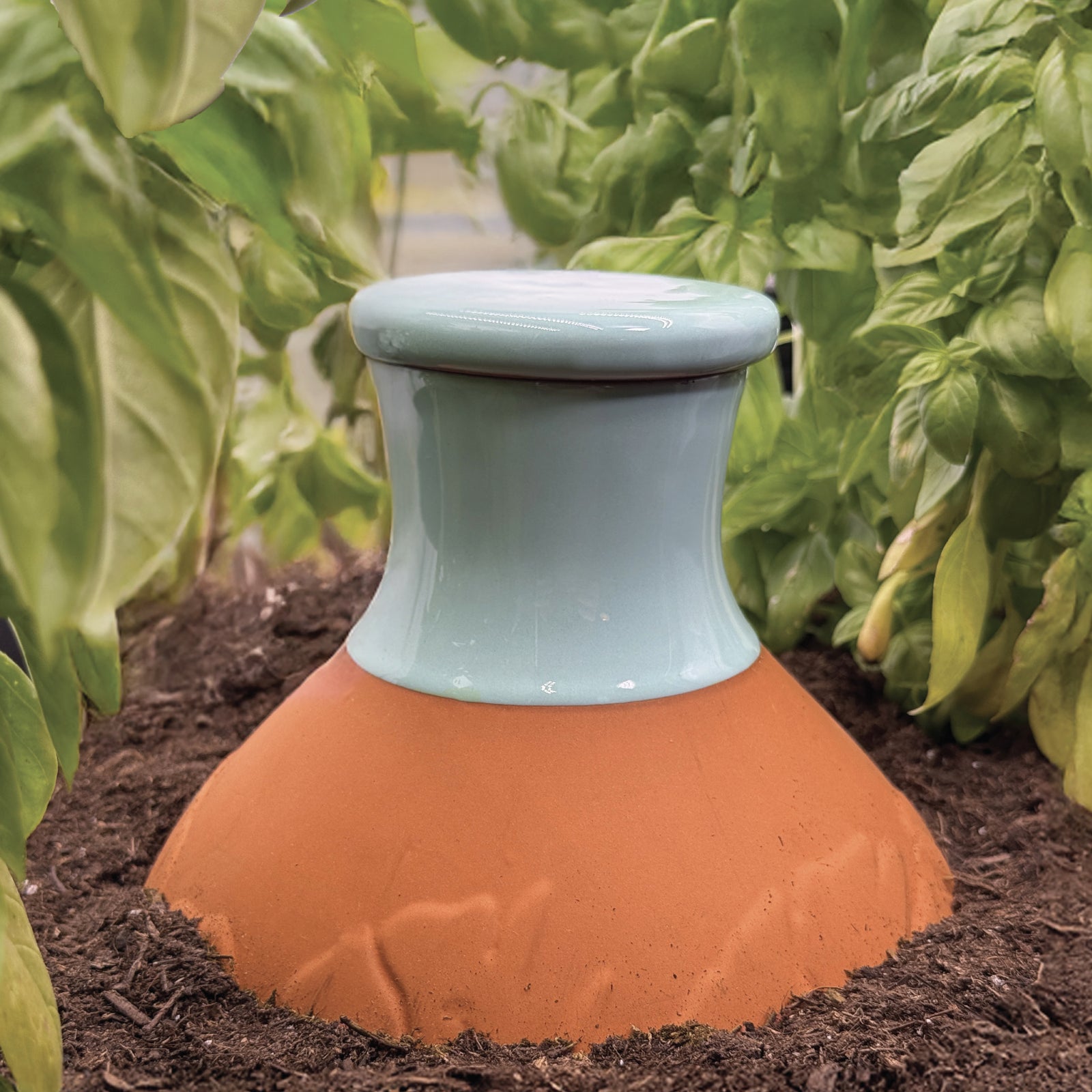
Small 0.5-gallon ollas cover about 4–9 square feet each, or one olla per 1–2 small pots. Medium 1-gallon ollas cover 9–12 square feet — one per 3×3 or 3×4 foot raised-bed section. A 1.25-gallon Acqua Olla covers 9–16 square feet, fitting a standard 3×3 or 4×4 foot raised bed with margin. Very large ollas (2+ gallons) cover 20–25 square feet.
These ranges are conservative. In sandy soils that drain fast, lean toward smaller coverage per olla. In dense clay soils that hold moisture broadly, you can stretch coverage. For detailed spacing recommendations, see olla spacing — how far apart to place ollas.
03 · PLANT-DRIVEN ADJUSTMENTS
How plant choice changes the count
Thirsty crops — tomatoes, peppers, melons, squash, cucumbers — pull water aggressively and effectively shrink the practical wetted zone. For these plants, plan one olla per 9–12 square feet. Drought-tolerant plants — rosemary, lavender, sage, native perennials — pull modestly and let one olla cover a larger area. For these, one olla per 16–25 square feet works fine.
01 · Small olla (0.5 gal)
4–9 sq ft
Covers a single container or 1–2 small in-ground plants. Best for tabletop setups and indoor pots.
02 · Medium olla (1 gal)
9–12 sq ft
Covers a 3×3 raised-bed section. Standard fit for most home garden patches.
03 · Acqua Olla (1.25 gal)
9–16 sq ft
Covers a 3×3 or 4×4 raised bed. Designed in California for slow-release coverage of the typical home bed.
04 · Large olla (2 gal+)
20–25 sq ft
Covers larger in-ground patches or wide raised beds. Less common at home scale.
Mixed-plant beds are the most common case. Size the olla count to the thirstiest plant in the group, not the average. The drought-tolerant plants in the same bed will simply pull less from the olla — they won’t suffer from being over-watered because the system is demand-driven. For plant-specific compatibility, see 10 plants that thrive with terracotta olla watering.
04 · RAISED BEDS
Olla count for standard raised-bed sizes
3×3 foot raised bed (9 sq ft): one 1.25-gallon Acqua Olla, centered. 4×4 foot bed (16 sq ft): one Acqua Olla, centered, or two smaller 1-gallon ollas at opposite ends if you have thirstier plants. 4×8 foot bed (32 sq ft): two Acqua Ollas, spaced about 4 feet apart along the long axis. 4×12 foot bed (48 sq ft): three Acqua Ollas at 4-foot intervals.
For larger in-ground gardens, repeat the pattern at 4-foot spacing across the bed. The wetted zones can overlap slightly without harm — the system is self-regulating, so overlap doesn’t over-water anything. For raised-bed setups specifically, see using ollas in raised beds — complete setup guide.
01 · Measure your bed
Note the square footage and shape. Rectangular beds spread ollas along the long axis; square beds center them.
02 · Identify thirstiest plant
The plant with highest water demand sets the olla count. Don’t average across the bed.
03 · Pick olla size
Acqua Olla (1.25 gal) fits most home beds. Sizing up reduces refill frequency; sizing down lets you cover odd shapes.
04 · Plot positions
Mark olla positions on the bed surface before digging. Aim for 3–4 foot spacing between centers.
05 · Plant around each
Place transplants within 12–18 inches of each olla center. Plants outside this radius won’t reach the wetted zone.
Edge note
Plants near the bed edge often dry out faster. Position ollas closer to bed edges than to center if you see edge stress.
05 · SOIL TYPE EFFECTS
How soil changes olla coverage
Loam and most garden soils: standard coverage applies. Clay soils: the wetted zone can extend slightly farther because clay holds moisture broadly, so coverage stretches by 10–20%. Sandy soils: water moves vertically through sand faster than it spreads laterally, so the wetted zone shrinks — expect 30–50% smaller coverage and plan more ollas per area.
If you garden in sand, the honest assessment is that ollas may underperform compared to surface drip irrigation. Some gardeners build a small clay-rich pocket around each olla to improve performance. For sandy-soil strategies, see what plants thrive with olla irrigation.
- Sketch the bed before digging. Plot olla positions on paper or in a garden-planning app. Saves do-overs.
- Account for permanent fixtures. Trellises, drip lines, and large established plants change practical olla placement.
- Plan for replacements. Ollas occasionally need replacement (every 3–10 years per how long olla pots last). Avoid placing them under permanent obstacles.
- Leave room to refill. Each olla needs a clear path to its lid for weekly refilling. Don’t bury one under a thicket of tomatoes.
- Verify spacing after first week. Test soil moisture at 12, 15, and 18 inches from each olla after a week of operation.
06 · TESTING YOUR SPACING
How to check if your spacing is correct
After installation and a week of operation, check the soil 12, 15, and 18 inches from each olla. The soil should be lightly moist at all three distances (test with a finger or moisture probe). If it’s dry at 12 inches, your spacing is too wide — add more ollas or reduce plant density. If it’s wet even at 18 inches and beyond, you can stretch spacing on the next install.
The plants themselves are also a signal. Vigorous, evenly growing plants across the bed mean the spacing is right. Wilting at the edges of the bed while center plants thrive means coverage is too narrow — add ollas near the edges.
One Acqua Olla covers 9–16 square feet of typical garden bed — enough for a standard raised bed of mixed vegetables. Bigger beds need more ollas at 4-foot spacing; smaller patches use a single olla. Size for your thirstiest plant and verify with a soil-moisture check after the first week. For spacing-specific guidance, see olla spacing — how far apart to place ollas.
FAQ · COMMON QUESTIONS
Frequently Asked Questions
How many ollas do you need per square foot?
For most home gardens, one 1.25-gallon Acqua Olla covers 9–16 square feet — about one per standard raised bed. Smaller 0.5-gallon ollas cover 4–9 square feet each. Thirsty crops shrink the coverage; drought-tolerant plants stretch it.
How big of an area does one olla cover?
A 1.25-gallon Acqua Olla covers a 3×3 to 4×4 foot patch — roughly 9–16 square feet — with a wetted zone extending 15–20 inches outward from the pot. Plants within that radius receive water; plants outside it don’t.
How many ollas in a 4x8 raised bed?
Two Acqua Ollas spaced about 4 feet apart along the long axis. For thirsty plantings like tomatoes, you can add a third in the middle for safety, but two is sufficient for most mixed plantings.
Can ollas overlap their wetted zones?
Yes — overlap is fine. The system is demand-driven, so overlapping zones don’t over-water. Some overlap is actually desirable in beds with thirsty plants because it ensures full coverage with no dry pockets.
How far apart should ollas be spaced?
Typically 3–4 feet between centers for 1-gallon ollas, slightly more for larger sizes. The spacing should let wetted zones touch or slightly overlap, so no soil between ollas stays dry. Detailed spacing guidance is in olla spacing — how far apart to place ollas.
Do I need more ollas for vegetables than for herbs?
Yes — vegetables transpire more and pull water harder, shrinking the practical wetted zone. Plan one olla per 9–12 sq ft for vegetable beds and one per 16–25 sq ft for herb or perennial beds.
How many ollas for a small container garden?
One small olla per container if the container is at least 12 inches across. Smaller containers don’t need ollas — a self-watering spike like the AcquaTerra is a better fit. See ollas for indoor plants — when they work and when they don't for container-specific guidance.
What happens if I have too few ollas?
Plants at the edges of your bed will show drought stress while plants near the olla thrive. The fix is to add ollas, not to refill the existing one more often — the issue is coverage, not capacity. Check soil moisture at 18+ inches from each olla to confirm.
References
01 Bainbridge, D. A. (2001). “Buried clay pot irrigation: a little known but very efficient traditional method of irrigation.” Agricultural Water Management, 48(2), 79–88. DOI: 10.1016/S0378-3774(00)00119-0
02 Food and Agriculture Organization (FAO). “Pitcher irrigation: A simple, low-cost irrigation technique.” FAO Agricultural Technology Series. fao.org