

Watering Sunflowers: A Complete Guide to Frequency and Method
Sunflowers (Helianthus annuus) are the fastest, tallest, thirstiest annual most gardeners will ever grow. A plant that goes from seed to eight feet in a single season has to move an enormous amount of water, and how you supply it — deeply and infrequently, or shallowly and often — decides whether you get a stout, self-supporting stem or a floppy one[1][2]. This complete guide to watering sunflowers covers the frequency, the seasonal schedule, the factors that genuinely move the numbers, the warning signs in both directions, and the watering method that builds the deep taproot sunflowers are famous for.
Water sunflowers deeply rather than often: aim for roughly 1–2 inches of water per week in the garden, delivered as one or two long soakings. In hot weather, and for tall varieties in full sun, expect to water every 2–3 days; in cool or wet spells, weekly or less. Containers need water far more often, sometimes daily. Always water at the base, not over the foliage. Established sunflowers are fairly drought-tolerant thanks to a deep taproot.
01 · THE SIMPLE ANSWER
How often to water sunflowers
In a garden bed, sunflowers want about 1–2 inches of water per week, counting rainfall, given as one or two deep soakings rather than daily sprinkles[1][3]. In practice that translates to watering every 2–3 days in hot summer weather, and roughly weekly in moderate conditions. Container-grown sunflowers are a different animal entirely and often need water daily in midsummer, because a large plant in a limited soil volume in full sun empties the pot fast.
The key word is deep. A sunflower develops a strong central taproot plus a dense lateral network, and it will only push that taproot down if moisture is available below the surface. Frequent shallow watering keeps the roots near the top of the soil, which produces a plant that wilts the moment you skip a day and blows over in the first storm. Long, slow soakings that wet the soil 8–12 inches down produce the opposite: a deeply rooted sunflower that can ride out a dry week[4].
Use the finger or trowel test rather than a fixed calendar. Push a finger 2 inches into the soil beside the plant; if it is dry at that depth, water thoroughly. Once established, sunflowers are fairly drought-tolerant — but there are two windows where water stress costs you real yield: the first two to three weeks after germination while roots are still shallow, and the three weeks around bud formation and bloom, when the head is being built[5].
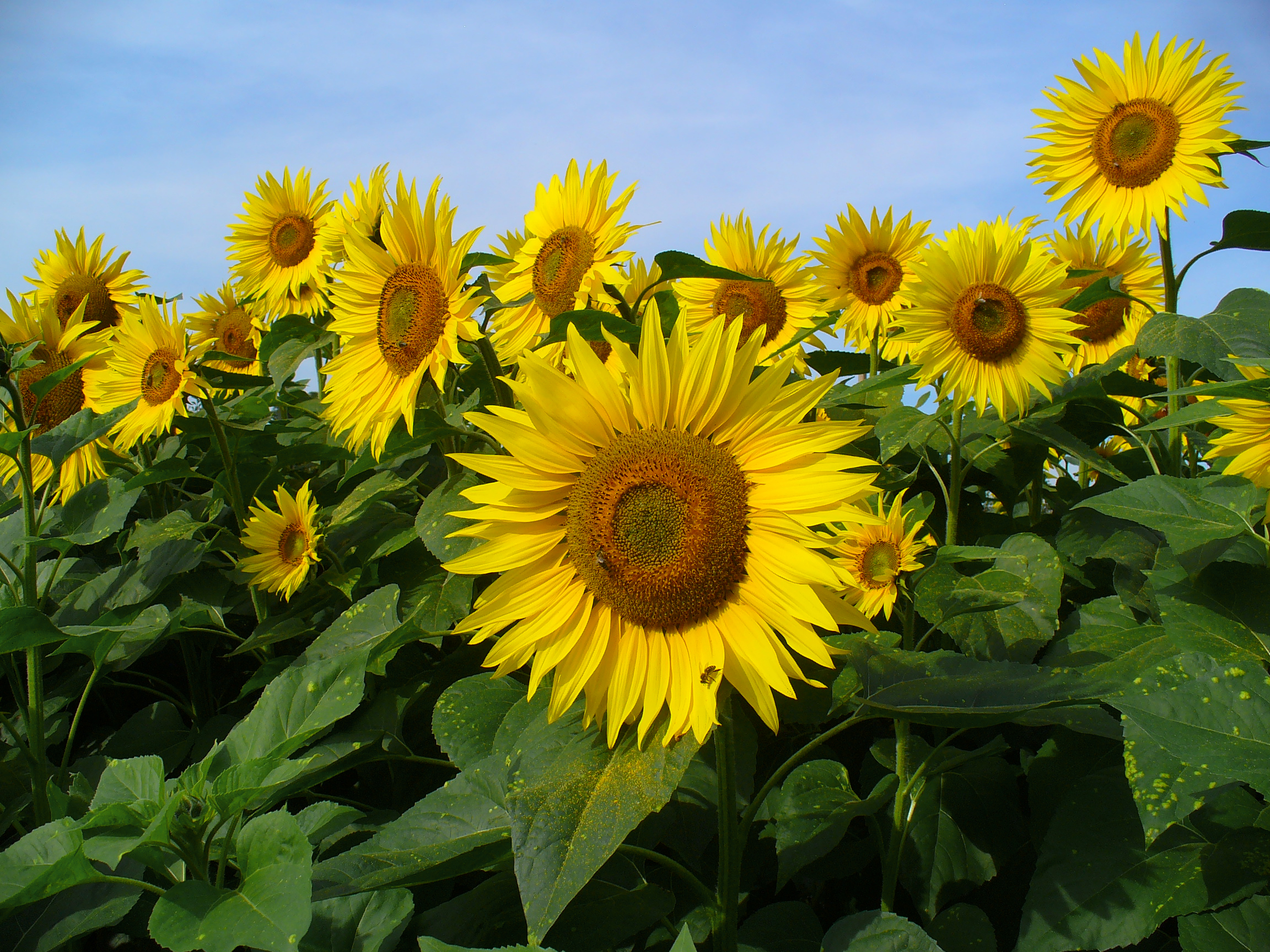
02 · THE BOTANY
Why sunflowers drink so much — and survive drought anyway
Two facts explain the whole watering picture. First, sunflowers carry a huge leaf area on a fast-growing stem, and every one of those broad leaves is transpiring in full sun all day. Water demand scales with leaf area and sunlight, so a mature sunflower in July is moving water at a rate that would drain a small pot several times over[6].
Second, sunflowers are unusually good at getting water. Helianthus annuus is a prairie annual with a strong taproot that can reach several feet down in loose soil, supported by a wide mat of laterals. That architecture is why established sunflowers are considered fairly drought-tolerant compared with shallow-rooted bedding plants: they can access reserves that other annuals cannot[4][7]. The catch is that the taproot only develops properly if you water in a way that encourages it downward.
Midday wilting in a heatwave is normal and not necessarily a signal to water. Big leaves lose water faster than even a good root system can supply during peak heat, so the plant droops temporarily and recovers in the evening. What matters is the state of the plant in the morning: a sunflower still wilted at 8 a.m. is genuinely short of water, and a plant that wilts every afternoon week after week is being underwatered at the root zone.
Watering method also has a disease dimension. Sunflowers are susceptible to downy mildew, rust, and Sclerotinia head and stem rot, all of which are favoured by prolonged leaf wetness and dense, humid canopies[8]. Watering at the base rather than over the top, and doing it in the morning, keeps foliage dry and materially reduces disease pressure.

03 · SEASONAL SCHEDULE
Sunflower watering schedule by season
Sunflowers are warm-season annuals: sown after the last frost, racing through the summer, finished by autumn. Their water demand follows that arc almost exactly, peaking at bud formation and bloom in midsummer[3][5].
01 · Spring (Mar–May)
Every 2–3 days
Sowing and seedling stage. Keep the top 1–2 inches evenly moist until plants are established, then start stretching the interval.
02 · Summer (Jun–Aug)
Every 2–3 days
Peak demand through budding and bloom. Deep soakings of 1–2 inches weekly minimum; containers often need water daily in heat.
03 · Fall (Sep–Nov)
Every 7–10 days
Heads mature and seeds fill. Taper watering as heads dry down; stop entirely if you are harvesting seed to avoid mould.
04 · Winter (Dec–Feb)
No watering
Annual sunflowers are killed by frost. Nothing to water — clear spent stems and plan next season's full-sun bed.
04 · FACTORS THAT MATTER
Six factors that change how often you water sunflowers
Heat and sun exposure: The single biggest variable. Sunflowers live in full sun by definition, so every extra degree of summer heat raises transpiration. A 90°F week can double how often you need to water compared with a mild, overcast one.
Variety height: Tall varieties such as ‘Russian Mammoth’ or ‘Titan’ carry vastly more leaf area than dwarf types like ‘Teddy Bear’ or ‘Sunspot’, and drink accordingly. Expect a 10-foot sunflower to need roughly twice the water of a 2-foot one in the same conditions.
Growth stage: Water need is modest at germination, climbs steeply through vegetative growth, and peaks in the three weeks spanning bud formation, flowering, and early seed fill. Drought at that peak stage directly shrinks the head[5].
Bed versus container: In-ground sunflowers tap deep soil moisture; container sunflowers cannot. A tall variety in a 14-inch pot in July may need watering every single day, sometimes twice, which is why large containers and moisture buffering matter so much for potted sunflowers.
Soil type and mulch: Sandy soils drain fast and need more frequent, smaller soakings; heavy clay holds water longer and needs less frequent but slower application. A 2–3 inch mulch layer over the root zone cuts evaporation substantially and evens out the swings[9].
Wind and spacing: Exposed, breezy sites dry both soil and foliage faster, and crowded plantings put neighbouring taproots in direct competition. Space tall varieties 18–24 inches apart so each plant has its own water reservoir to draw on.

05 · UNDERWATERING SIGNS
Signs your sunflowers need water
Sunflowers show thirst clearly, but you have to read the timing to tell true drought stress from ordinary midday heat droop[3]:
- Wilting that persists into the morning. Afternoon droop in a heatwave is normal. Leaves still limp at sunrise mean the root zone is genuinely dry — water deeply that day.
- Dry, crispy lower leaves. The plant sacrifices its oldest leaves first under drought stress, browning and dropping them from the bottom up while the top stays green.
- Small heads and stalled height. Water stress during budding produces a head noticeably smaller than the variety should give, and a plant that stops gaining height weeks early.
- Cracked soil and rapid runoff. Bone-dry soil shrinks and turns water-repellent, so water runs off the surface instead of soaking in. Water slowly in stages to rewet the profile properly.
06 · OVERWATERING SIGNS
Signs you have overwatered your sunflowers
Sunflowers dislike waterlogged soil as much as they dislike drought, and constantly saturated ground invites root and stem rot — especially in heavy clay or poorly drained beds[8][10]:
- Wilting in wet soil. The most misleading sign. A sunflower drooping while the ground is soggy has damaged roots that can no longer take up water. Stop watering and improve drainage rather than adding more.
- Yellowing leaves from the bottom up with soggy ground. Widespread yellowing plus soil that never dries points to oxygen-starved roots, not hunger or thirst.
- Soft, discoloured stem base. Mushy or water-soaked tissue at the soil line signals stem rot, often followed by sudden collapse of an otherwise large plant.
- Mould on foliage or the flower head. Overhead watering plus persistent leaf wetness encourages downy mildew, rust and head rot. Water at the base, in the morning, and thin crowded plantings for airflow.
Prevention beats cure with a fast annual: plant in free-draining soil, never site sunflowers in a low spot that collects runoff, and let the top couple of inches dry between deep soakings.

07 · THE METHOD
How to actually water a sunflower
Water at the base of the plant, never over the foliage. Direct the hose, can, or drip line to the soil around the stem so the root zone gets the water and the leaves stay dry. Wet foliage is the main driver of sunflower leaf disease, and overhead sprinkling also wastes a lot of water to evaporation in full sun[8].
Go slow and go deep. For an established garden sunflower, that means a long, low-pressure soak that wets the soil 8–12 inches down — typically several gallons per plant, applied over minutes rather than seconds. A quick blast runs off the surface and does almost nothing for the taproot.
Water in the early morning. Cooler air and calmer conditions mean less evaporative loss, and any splashed foliage dries quickly through the day, cutting fungal risk. Evening watering leaves leaves damp overnight, which is exactly what mildew and rust want.
Mulch after watering, not before your first soak. A 2–3 inch layer of straw, bark or compost over damp soil holds that moisture in and can cut watering frequency by a third in peak summer. Keep the mulch an inch clear of the stem itself to avoid rot at the collar.
For container sunflowers, water until it drains freely from the bottom, empty any saucer, and check daily in hot weather. Large containers, light-coloured pots, and a buffered water supply all reduce the chance of a tall potted sunflower collapsing between waterings.
08 · TEMPERAMENT & QUICK FACTS
What sunflowers are really like
Origin. Helianthus annuus is an annual member of the daisy family (Asteraceae), native to North America, where it grew on open plains, prairies and disturbed ground before being domesticated thousands of years ago for its oil-rich seed[11][12]. That prairie background explains everything about how it drinks: it expects sun, wind, and periodic dry spells, and it answers them with a deep taproot rather than by fussing.
Personality. Sunflowers are fast, forgiving, and undramatic compared with a coleus or a hydrangea. They germinate readily from direct-sown seed, resent transplanting, and mostly want to be left alone in a sunny bed with deep water at sensible intervals. Their main quirks are appetite for light, a tendency to lean when short of it, and a habit of afternoon wilting in heat that alarms new growers unnecessarily.
Size. Enormous range. Dwarf container varieties finish around 1–2 feet, standard garden types run 5–8 feet, and mammoth varieties regularly exceed 10 feet with heads a foot across. Height maps almost directly onto water demand, so choose the variety with your watering capacity in mind.
Toxicity. Sunflowers are not on the ASPCA's list of plants toxic to dogs, cats, or horses, and are generally regarded as a pet-safe garden flower — a rarity worth knowing if you garden with animals around. Check the ASPCA database for any specific plant before assuming safety[13].
Cultivars. Single-stem giants such as ‘Russian Mammoth’ and ‘Titan’ produce one huge head; branching cut-flower types like ‘Autumn Beauty’ and the pollen-free ‘ProCut’ series give many smaller stems over a long season; dwarfs such as ‘Teddy Bear’ and ‘Sunspot’ are bred for pots and window-side beds. All share the same watering logic — deep and infrequent — scaled to their size. For a shorter, frequency-focused reference see how often to water sunflowers, and to get the light half of the equation right, read sunflower light requirements.
ACQUA OLLA
Slow, deep root-zone hydration for sunflowers in garden beds and large containers — without wetting the foliage.
Shop Acqua Olla →Watering sunflowers well comes down to three habits: deep soakings of 1–2 inches per week rather than daily sprinkles, water delivered at the base in the early morning, and extra attention during the two critical windows — establishment and bud formation. Scale it up for tall varieties, hot weather, and containers, and lean on the plant's deep taproot the rest of the time. Then match the light: see sunflower light requirements.
Frequently asked questions about watering sunflowers
How often should I water sunflowers?
Aim for 1–2 inches of water per week as one or two deep soakings. In hot weather that usually means every 2–3 days; in cool or rainy spells, weekly or less. Container sunflowers often need water daily in summer.
How much water does a sunflower need?
Roughly 1–2 inches per week including rainfall, applied slowly enough to wet the soil 8–12 inches deep. Tall varieties need considerably more than dwarf types because of their much larger leaf area.
Are sunflowers drought-tolerant?
Fairly, once established. A deep taproot lets sunflowers reach moisture other annuals cannot. Seedlings and plants at bud formation are the vulnerable stages — drought then costs you head size directly.
Should I water sunflowers from above or at the base?
Always at the base. Wet foliage encourages downy mildew, rust and head rot, and overhead watering loses a lot to evaporation in full sun. Water the soil around the stem, in the early morning.
Why is my sunflower wilting in the afternoon?
Usually normal heat droop — big leaves lose water faster than roots can supply at peak heat, and the plant recovers by evening. If it is still wilted in the morning, the soil is genuinely dry and needs a deep soak.
How often to water sunflowers in pots and containers?
Much more often than in the ground — often daily in midsummer, sometimes twice a day for tall varieties in small pots. Use the largest container you can, mulch the surface, and water until it drains freely.
Can you overwater sunflowers?
Yes. Constantly saturated soil starves roots of oxygen and invites root and stem rot — look for wilting in wet soil, yellowing lower leaves, and a soft stem base. Plant in free-draining soil and let the top inches dry between soakings.
References
- [1] Royal Horticultural Society. (n.d.). Sunflowers / RHS Gardening. rhs.org.uk.
- [2] Missouri Botanical Garden. (n.d.). Helianthus annuus — Plant Finder. missouribotanicalgarden.org.
- [3] University of Minnesota Extension. (2021). Growing sunflowers in home gardens. extension.umn.edu.
- [4] Clemson Cooperative Extension. (n.d.). Sunflower. Home & Garden Information Center. hgic.clemson.edu.
- [5] Schneiter, A.A., & Miller, J.F. (1981). Description of sunflower growth stages. Crop Science, 21(6), 901–903.
- [6] Taiz, L., & Zeiger, E. (2010). Plant Physiology, 5th ed. Sinauer Associates.
- [7] Lambers, H., Chapin, F.S., & Pons, T.L. (2008). Plant Physiological Ecology, 2nd ed. Springer.
- [8] North Dakota State University / North Carolina State Extension. (n.d.). Sunflower diseases and Helianthus annuus culture. NC Extension Gardener Plant Toolbox. plants.ces.ncsu.edu.
- [9] Penn State Extension. (2020). Mulching and watering the home garden. extension.psu.edu.
- [10] University of Wisconsin–Madison Division of Extension. (n.d.). Sunflower, Helianthus annuus. hort.extension.wisc.edu.
- [11] Royal Botanic Gardens, Kew. (n.d.). Helianthus annuus L. Plants of the World Online. powo.science.kew.org.
- [12] USDA, Agricultural Research Service. (2023). GRIN Taxonomy: Helianthus annuus. npgsweb.ars-grin.gov.
- [13] ASPCA. (n.d.). Toxic and non-toxic plants list. Animal Poison Control. aspca.org.
- [14] University of Florida IFAS Extension. (2021). Sunflowers. Gardening Solutions. gardeningsolutions.ifas.ufl.edu.
- [15] Michigan State University Extension. (n.d.). Watering the home garden efficiently. canr.msu.edu.