

How Often to Water a Peace Lily
The peace lily (Spathiphyllum) is among the most communicative houseplants you can own. When it needs water, its leaves droop dramatically and unmistakably; when it’s rehydrated, it perks back up within hours. This makes peace lilies one of the easiest plants to learn watering on, even for new houseplant owners. But the wilt-and-perk cycle is also a trap: peace lily owners often let the plant dry to dramatic wilt every time, which over months damages roots and weakens the plant[1]. This guide covers how often to water a peace lily based on research, what to watch for besides the wilt signal, and how to avoid the most common peace lily watering mistakes.
Water a peace lily approximately once per week when the top inch of soil is dry. Spring and summer: every 5–7 days. Fall and winter: every 7–10 days. Don’t wait for dramatic wilting — chronic wilt-then-rehydrate cycles damage roots over time. Aim to water before leaves visibly droop.
01 · THE SIMPLE ANSWER
How often to water a peace lily
In typical indoor conditions — medium light, household temperatures of 65–80°F, and standard houseplant soil — a peace lily needs water approximately every 5–10 days, more often in summer (every 5–7 days) and less in winter (every 7–10 days)[1][2]. Peace lilies prefer their soil consistently lightly moist — not soggy and not bone-dry. The top inch of soil should dry between waterings, but the bulk of the rootball should stay slightly moist.
Spathiphyllum is a genus of about 40 species native to tropical rainforests of Central and South America, plus Southeast Asia[3]. The cultivated peace lilies sold as houseplants are mostly hybrids derived from Spathiphyllum wallisii and related species[4]. In the wild, these plants grow in shaded rainforest understory near streams and seepages — consistently moist, never dry, never flooded. Indoors, replicating that “evenly moist but well-drained” condition is the entire goal.
Use the finger test: stick a finger 1 inch into the soil. If dry, water. If still moist, wait 1–2 days. Try to water before leaves droop visibly — consistent moisture management is gentler on the plant than wilt-and-perk cycles.
02 · THE BOTANY
Why peace lilies wilt so dramatically
Peace lily leaves emerge directly from underground rhizomes and consist of a long petiole supporting a single broad blade. The petiole maintains its upright posture through internal water pressure (turgor) in specialized cells called pulvini at the leaf base[5][6]. When soil moisture drops below a critical threshold, water moves out of these cells faster than it can be replaced from the roots, and the leaves visibly droop within hours.
This is dramatic but reversible: water the plant thoroughly and the leaves regain turgor and posture within 1–3 hours. However, repeated wilt-to-rehydration cycles damage the root system over time, leading to chronic leaf yellowing and reduced flowering[7]. The plant survives but doesn’t thrive.
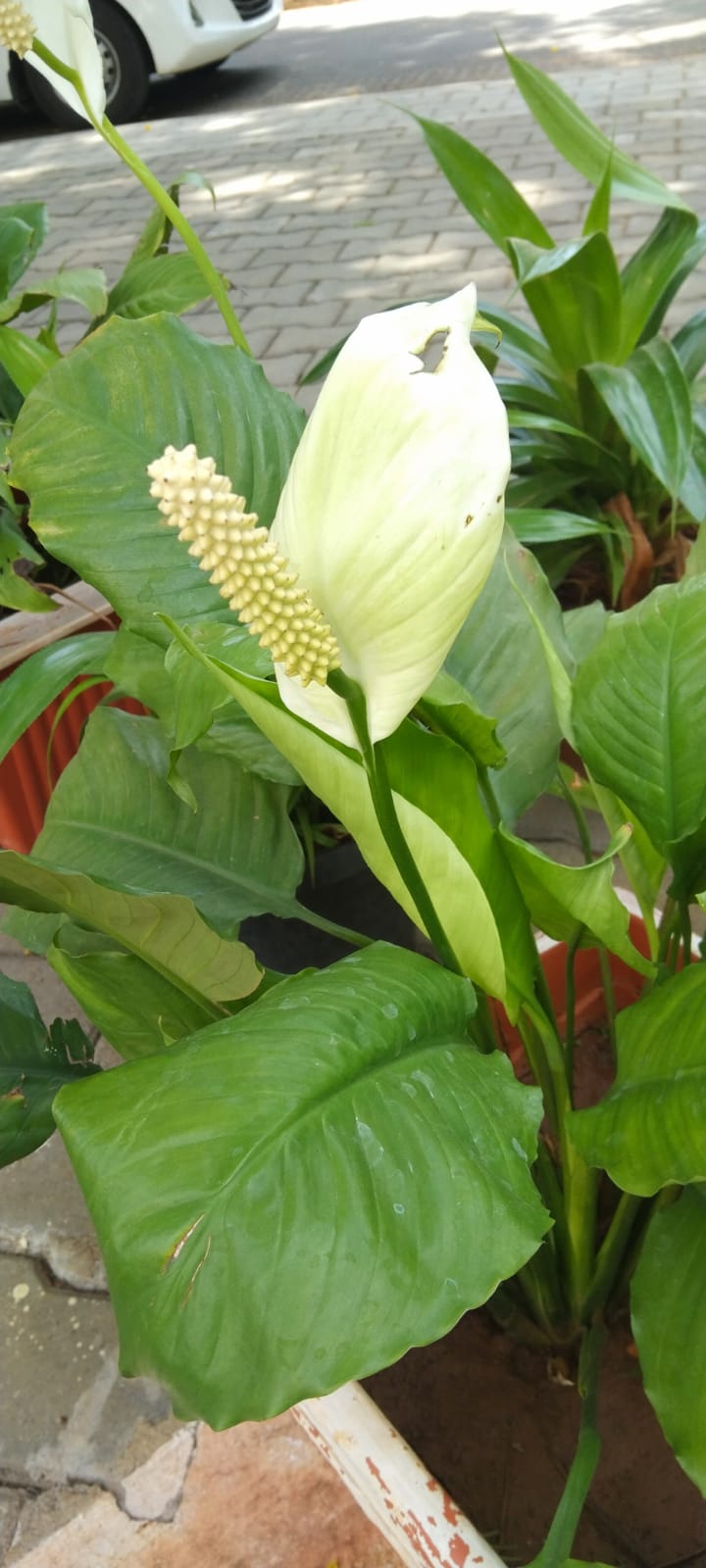
Peace lilies were among the fifteen plants identified in the NASA Clean Air Study as effective at removing common indoor pollutants[8], which contributed to their broad popularity. The flowering structure — the white spathe surrounding a yellow-green spadix — is technically a modified leaf, not a flower. True flowers are the tiny structures on the spadix itself. Adequate watering and indirect light produce flowering; chronic stress prevents it[9].
03 · SEASONAL SCHEDULE
Peace lily watering schedule by season
Peace lilies grow year-round indoors but slow meaningfully in winter as light decreases. Below are typical intervals for an established peace lily in an 8–10 inch pot[1][2].
01 · Spring (Mar–May)
Every 5–7 days
Active growth resumes. New leaves emerge and flowering may begin.
02 · Summer (Jun–Aug)
Every 4–7 days
Peak growth and flowering. Brighter rooms increase water demand.
03 · Fall (Sep–Nov)
Every 7–10 days
Growth slows. Stretch intervals gradually as light decreases.
04 · Winter (Dec–Feb)
Every 7–14 days
Minimal growth. Cooler rooms can stretch intervals to 10–14 days.
04 · FACTORS THAT MATTER
Six factors that change how often you water a peace lily
Light: Peace lilies tolerate low light but flower only in medium-to-bright indirect light[9]. Brighter conditions roughly double water use vs. dim corners.
Pot size and material: Larger pots dry slower; smaller pots dry faster. Terracotta dries faster than plastic or glazed ceramic. A peace lily in a 6-inch nursery pot may need watering every 4–5 days during peak growth; the same plant transplanted to an 8-inch glazed ceramic pot may need watering every 7 days.
Soil mix: Standard houseplant potting mix with 15–20% perlite for drainage works well[10]. Peace lilies tolerate slightly heavier soil than most houseplants because they prefer moisture retention — but never use compacted or poorly-draining mixes.
Humidity: Higher humidity (50%+) slows leaf transpiration; dry indoor air (below 30%) speeds it up. Brown leaf tips often indicate low humidity rather than under-watering.
Temperature: Warm rooms (75°F+) accelerate water use; cool rooms (60°F or below) slow it dramatically. Peace lilies dislike cold drafts and decline below 55°F.
Plant maturity and bloom: Actively flowering peace lilies use slightly more water than vegetative plants. Mature, multi-crowned plants in 10-inch+ pots use substantially more water than young single-crown plants.
05 · UNDERWATERING SIGNS
Signs your peace lily needs water
Peace lilies are unusually clear about thirst — the wilt signal is one of the most reliable communications in houseplant care[7].
- Leaves visibly droop or wilt. The unmistakable peace lily thirst signal. Petioles lose firmness and leaves angle downward. Watering reverses the wilt within 1–3 hours.
- Leaf edges turn crispy brown. Chronic under-watering or low humidity browns leaf tips and edges. Damage is permanent on affected leaves but new growth will be normal.
- Soil pulls away from pot edges. Severely dry soil shrinks. Water poured in may channel down the gap without saturating the rootball — bottom-soak the pot in a basin to rehydrate.
- Yellow lower leaves. Chronic drought causes the plant to sacrifice its oldest leaves. A few yellow lower leaves over months is normal aging; multiple yellow leaves at once indicates watering schedule problems.
Don’t treat the wilt signal as a normal watering schedule. Letting peace lilies wilt before every watering damages roots over months and weakens flowering. Aim to water just before the wilt point — when the top inch of soil is dry but leaves are still upright.
06 · OVERWATERING SIGNS
Signs you’ve overwatered your peace lily
Peace lilies tolerate more moisture than many houseplants but root rot is still possible with chronic over-saturation[11][12].
- Persistent yellow leaves throughout the plant. Yellowing affecting multiple leaves — especially recently emerged ones — signals root rot. A wilting peace lily that doesn’t recover after watering has progressed to root rot.
- Soft or mushy crown. The base of the plant where leaves emerge should be firm. Softness signals rot reaching the crown — cut affected leaves at the base and inspect the rhizome.
- Persistent soil sogginess. Soil that stays wet for over a week post-watering indicates poor drainage or over-watering. Confirm drainage holes are clear and consider downsizing the pot.
- Wilting that doesn’t reverse with watering. Healthy peace lilies perk up within hours of watering. A wilted plant that stays wilted after thorough watering has root damage — unpot immediately to inspect.
Recovery requires unpotting, trimming damaged roots, and repotting in fresh well-draining soil. See how to stop overwatering houseplants for the full protocol.
07 · THE METHOD
How to actually water a peace lily
Water thoroughly until water drains from the pot’s holes — usually 2–3 cups (475–700 ml) for an 8-inch pot[10]. Even saturation matters. Partial watering encourages shallow roots that wilt faster between waterings.
Bottom watering works well for peace lilies. Set the pot in a basin for 15–30 minutes, let the soil draw water through drainage holes, then drain completely. This method ensures even rootball saturation without splashing water onto the crown.
Empty saucers immediately after watering. Peace lily roots sitting in standing water rot.
Use room-temperature water. Cold water can shock the rootball, particularly in winter. Peace lilies are moderately sensitive to chlorinated tap water — if leaf tips brown despite consistent watering, switch to filtered or rainwater.
08 · AWAY FROM HOME
Watering your peace lily while you’re away
Peace lilies are moisture-loving plants that don’t tolerate extended absence as easily as drought-tolerant plants do[7]. For trips up to 7 days, water deeply 24 hours before departure. For 7–14 day absences, a slow-release watering tool like an AcquaTerra terracotta watering spike inserted in the soil delivers consistent moisture without the rot risk of pre-departure over-watering.
For complete vacation protocols for peace lilies, see how to water a peace lily while away. For general houseplant trip planning, see how to care for houseplants while on vacation. For ferns and calatheas (similar moisture-loving plants), see indoor plant waterer for ferns and calatheas.
The most common vacation watering mistake with peace lilies: over-watering before leaving in hopes of buying extra time. This causes root rot. Stick to a single normal watering 24 hours before departure, OR install a self-watering spike. Never both. For longer absences than 2 weeks, ask a sitter.
ACQUATERRA
Consistent moisture for peace lilies — the watering pattern they prefer.
Shop AcquaTerra →Peace lily watering is simpler than most houseplants because the plant tells you when it needs water. Weekly watering when the top inch of soil dries is the baseline; the wilt signal is your safety net. Don’t let the plant wilt every time as a watering trigger — aim to water just before the wilt point for healthier roots and better flowering. For vacation specifics, see how to water a peace lily while away. For overwatering recovery, see how to stop overwatering houseplants.
Frequently asked questions
How often should I water my peace lily?
Water approximately once per week when the top inch of soil is dry. Spring and summer: every 5–7 days. Fall and winter: every 7–10 days. Don’t wait for dramatic wilting — aim to water just before leaves visibly droop.
How do I know when my peace lily needs water?
Stick a finger 1 inch into the soil. If dry, water. The plant will also visibly droop when significantly thirsty, recovering within hours of watering. Aim to water before the wilt point.
How often to water a peace lily indoors?
Indoors in standard conditions, every 5–10 days depending on season and light. Bright rooms shorten the interval; dim corners stretch it. Always use the finger test.
Should I let my peace lily droop before watering?
No. Letting peace lilies droop before each watering damages roots over months. Use the finger test (top inch dry) as your watering signal, and treat the wilt point as a safety net rather than a regular trigger.
How much water does a peace lily need?
Approximately 2–3 cups (475–700 ml) per watering for an 8-inch pot, or enough to drain freely from the pot’s holes. Thorough infrequent watering is better than frequent shallow watering.
Why is my peace lily turning yellow?
Multiple yellow leaves at once typically signals root rot from overwatering. A peace lily that wilts and doesn’t recover after watering has progressed to root damage. See how to stop overwatering houseplants for recovery protocol.
How often to water a peace lily in winter?
Every 7–14 days in winter, sometimes longer in cool rooms or low light. Peace lilies slow substantially in winter and use meaningfully less water.
Should I bottom-water my peace lily?
Bottom watering works very well for peace lilies. Set the pot in a basin for 15–30 minutes, let soil draw moisture through drainage holes, then drain. This ensures even saturation without splashing the crown.
References
- [1] Royal Horticultural Society. (n.d.). Spathiphyllum wallisii / RHS Gardening. rhs.org.uk.
- [2] Missouri Botanical Garden. (n.d.). Spathiphyllum — Plant Finder. missouribotanicalgarden.org.
- [3] Bunting, G.S. (1960). A revision of Spathiphyllum (Araceae). Memoirs of the New York Botanical Garden, 10(3), 1–54.
- [4] Mayo, S.J., Bogner, J., & Boyce, P.C. (1997). The Genera of Araceae. Royal Botanic Gardens Kew.
- [5] Satter, R.L., & Galston, A.W. (1981). Mechanisms of control of leaf movements. Annual Review of Plant Physiology, 32, 83–110.
- [6] Taiz, L., & Zeiger, E. (2010). Plant Physiology, 5th ed. Sinauer Associates.
- [7] University of Florida IFAS Extension. (2018). Spathiphyllum — Peace Lily. edis.ifas.ufl.edu.
- [8] Wolverton, B.C., Johnson, A., & Bounds, K. (1989). Interior Landscape Plants for Indoor Air Pollution Abatement. NASA Technical Report TM-101766.
- [9] Henley, R.W., Poole, R.T., & Chase, A.R. (1991). Foliage Plant Research at the University of Florida. UF/IFAS Extension.
- [10] Penn State Extension. (2020). Houseplant Care: Watering, Fertilizing, and Repotting. extension.psu.edu.
- [11] Daughtrey, M.L., & Benson, D.M. (2005). Principles of plant health management for ornamental plants. Annual Review of Phytopathology, 43, 141–169.
- [12] Lambers, H., Chapin, F.S., & Pons, T.L. (2008). Plant Physiological Ecology, 2nd ed. Springer.
- [13] North Carolina State Extension. (2022). Spathiphyllum. plants.ces.ncsu.edu.
- [14] USDA, Agricultural Research Service. (2023). GRIN: Spathiphyllum wallisii. npgsweb.ars-grin.gov.
- [15] University of Minnesota Extension. (2021). Houseplant Care. extension.umn.edu.