

Self Watering Globes vs Drip Spikes: Which Is Better?
Self-watering globes look pretty on a shelf. Drip spikes give you actual control over how much water your plant gets. Here’s the real comparison.
Self-watering globes and drip spikes both promise the same thing: keep your plants watered without daily attention. But they work in fundamentally different ways, and the difference matters for your plants’ health. If you’ve ever come home from vacation to find a watering globe emptied in 2 days or a plant sitting in a puddle, you’ve experienced the core problem with devices that offer no flow control.
This post compares self-watering globes vs. drip spikes across every dimension that matters — capacity, flow control, reliability, durability, and which plants work best with each. If you’re deciding between the two for your houseplants, this is the comparison that will actually help you choose.
20 oz
vs. 6–12 oz
Dynamic Dripper capacity vs. the typical glass watering globe.
Adjustable
vs. no flow control
A valve you turn vs. a glass neck at the mercy of whatever soil it’s pushed into.
30 days
vs. 2–7 days
Maximum duration with an adjustable spike vs. typical globe runtime.
01 · Head to Head
Self-watering globes vs. drip spikes
| Feature | Watering globes | Drip spikes (Dynamic Dripper) |
|---|---|---|
| Capacity | 6–12 oz (typical) | 20 oz per unit |
| Flow control | None — depends on soil density and neck opening | Adjustable valve with flow knob |
| Duration | 2–7 days (unpredictable) | Up to 30 days (user-controlled) |
| How it works | Gravity + soil absorption through narrow glass neck | Gravity-fed adjustable valve drips at a set rate |
| Refill method | Remove from soil, fill at sink, reinsert | No-removal — unscrew cap, pour, reseal |
| Durability | Glass — shatters if dropped or tipped | LDPE plastic — BPA-free, recyclable, durable |
| Pack size | Usually 2–4 per set | 3-pack (bottle + spike + valve each) |
| Soil disruption | Thick glass neck displaces soil on insertion | Slim spike, minimal disruption |
| Predictability | Low — varies by soil type, compaction, humidity | High — count seconds between drops, adjust as needed |
02 · Flow Control
Why self watering globes don’t deliver water reliably
Self-watering globes release water through a narrow glass neck based on soil absorption. When the soil around the neck is dry, air enters the globe and water flows out. When the soil is wet, flow slows. In theory, this creates a self-regulating system. In practice, the results are highly unpredictable.

The flow rate depends on variables the globe can’t control: how densely packed the soil is around the neck, the soil’s composition (peat-heavy mixes drain differently than perlite-heavy ones), the humidity in the room, and even how deeply the globe is inserted.
Two identical globes in two identical pots can empty at very different rates. There’s no way to adjust the flow — you’re at the mercy of soil conditions.
The University of Minnesota Extension notes that the most effective approach to watering houseplants is matching the delivery rate to the specific plant’s needs — something a fixed-flow globe cannot do but an adjustable drip spike can.1
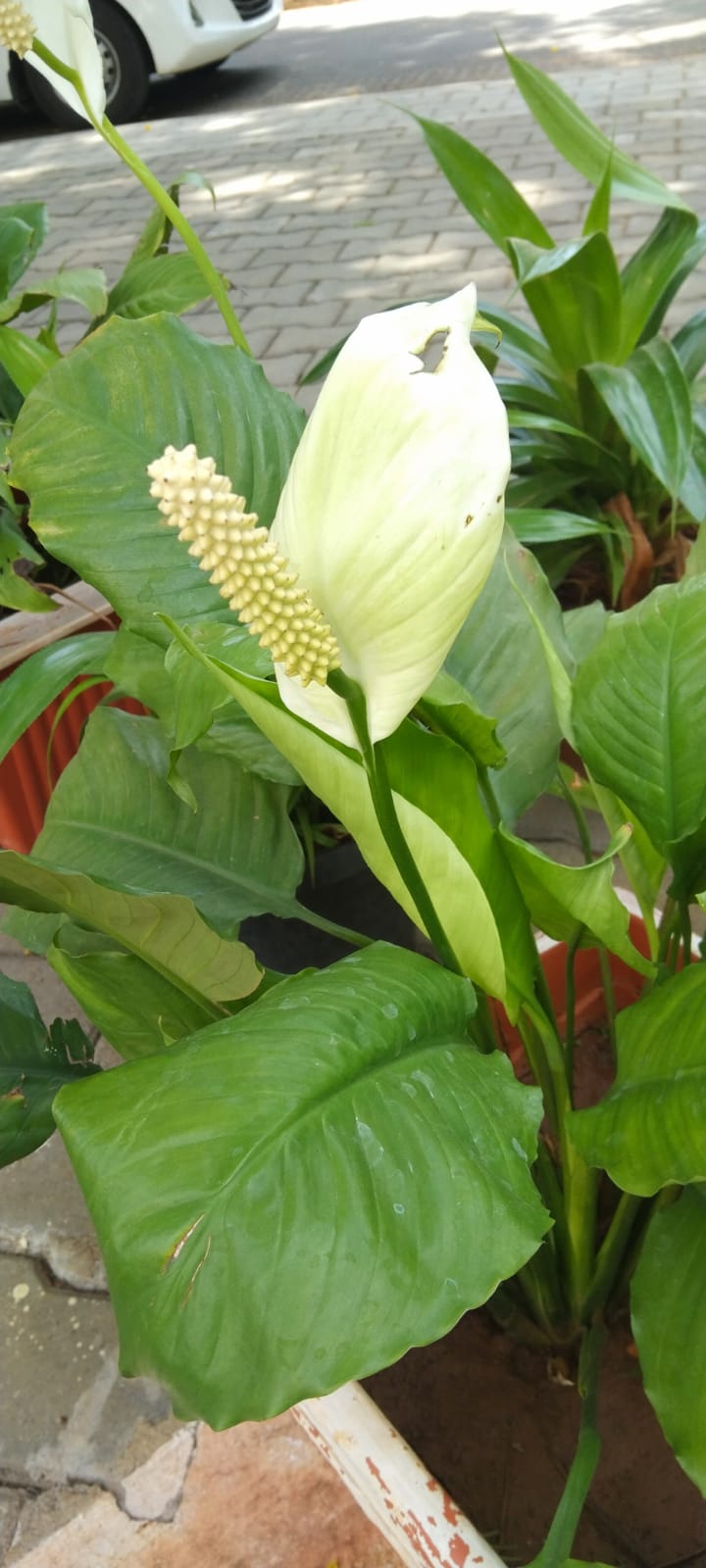

The peace lily problem
Peace lilies are sensitive to inconsistent watering — the unpredictable flow of watering globes can cause the same stress cycles as hand-watering. A globe that empties in 2 days leaves the peace lily dry for the rest of your trip. An adjustable drip spike set to 1 drop every 30–60 seconds delivers the steady moisture peace lilies need for the full duration.
03 · Reliability
Are drip spikes better than watering globes?
A drip spike with an adjustable valve — like the BabaBerry Dynamic Dripper — puts you in control of the flow rate. You turn the knob, count seconds between drops with your phone’s stopwatch, and micro-adjust until you reach the exact rate your plant needs.
A peace lily that needs 2–3 oz per day gets 2–3 oz per day. A snake plant that needs half an ounce gets half an ounce. The valve makes this possible; a glass globe does not.
The Dynamic Dripper is gravity-fed, so the drip rate does slow naturally as the reservoir empties (following Torricelli’s law).3 But the starting rate is within your control, and the slowdown is predictable and gradual — unlike the abrupt stop-start behavior of watering globes that can suddenly empty or clog based on soil shifts around the glass neck.
04 · Capacity
Watering globe capacity vs. drip spike capacity
Most self-watering globes hold between 6 and 12 oz of water. The Dynamic Dripper holds 20 oz per unit. That capacity difference directly translates to duration: a globe that holds 8 oz at a moderate flow rate lasts 2–4 days. A 20 oz drip spike at the same flow rate lasts 8–17 days. For vacation watering — the #1 use case for both products — capacity is the difference between coverage and failure.2
05 · Durability
Are watering globes durable? Glass vs. LDPE plastic
Glass watering globes shatter. They tip over, roll off shelves, get knocked by pets, and break during refilling. One dropped globe means broken glass in your potting soil and on your floor.
The Dynamic Dripper’s LDPE plastic bottles are thick, durable, and BPA-free. They don’t break if tipped. They’re fully recyclable. And the custom-fit threading means the bottle-to-spike connection is leak-free — no dripping at the joint, no puddles under the pot.
06 · Refilling
Refilling watering globes vs. drip spikes
To refill a watering globe, you pull it from the soil (disturbing roots), carry it to the sink (dripping water along the way), fill it, and push it back into the soil (disturbing roots again). The Dynamic Dripper has a large removable top cap — unscrew it, pour water in, screw it back on. The spike stays in the soil. The roots stay undisturbed. For plants that hate being moved or poked — calatheas, nerve plants, ferns — this is a meaningful advantage.


07 · When Globes Work
When watering globes still make sense
Watering globes aren’t completely without merit. They’re inexpensive, widely available, and work acceptably for short absences (2–3 days) with forgiving plants like pothos and spider plants that tolerate a wide range of moisture levels. If you want a decorative element in a pot and aren’t leaving for more than a long weekend, a globe can do the job.
But for anything longer than 3–4 days, for plants with specific moisture requirements, or for any situation where predictability matters, an adjustable drip spike is the better tool.
THE BOTTOM LINE
Self-watering globes give you no control over flow rate, hold less water, break easily, and deliver unpredictable results. Adjustable drip spikes like the Dynamic Dripper give you precise flow control, 20 oz of capacity, durable construction, and no-removal refilling. For reliable vacation plant watering and daily hands-off care, drip spikes are the clear upgrade.
The self watering globes vs drip spikes question comes down to one variable: control. A watering globe gives you a decorative object that releases water at whatever rate your soil happens to allow. An adjustable drip spike gives you a measurable, repeatable flow rate that you tune to your specific plant and your specific trip. For anyone serious about indoor plant care — especially for vacation watering — the upgrade from globes to adjustable drip spikes is the single highest-leverage change you can make to your watering setup.
08 · FAQ
Self watering globes vs drip spikes: common questions
How long do self watering globes last?
Most self-watering globes hold 6–12 oz of water and last 2–7 days depending on soil density, plant water demand, and room conditions. The duration is unpredictable because globes have no flow control. An adjustable drip spike like the Dynamic Dripper holds 20 oz and lasts up to 30 days at the slowest setting because you control the rate.
Are drip spikes better than watering globes?
Drip spikes are better than watering globes for any situation where predictability matters: long vacations, moisture-sensitive plants, or any plant where overwatering is a real risk. Adjustable drip spikes let you set the exact flow rate; globes deliver water at a rate dictated by soil conditions you can’t control. For short weekend trips with forgiving plants, a watering globe is acceptable.
Do self watering globes work for vacation plant watering?
Self-watering globes work for short absences of 2–3 days with drought-tolerant plants like pothos or spider plants. For longer trips, plants in bright light, or anything moisture-sensitive (calatheas, ferns, nerve plants), the 6–12 oz capacity and unpredictable flow rate make globes unreliable. An adjustable drip spike with a 20 oz reservoir is a better choice for trips of 1–3 weeks.
Why do watering globes empty so fast?
Watering globes release water faster in loose, sandy, or freshly-watered soil because air can enter the globe more easily. They also drain quickly in warm, dry rooms where evaporation pulls water through the neck faster. There’s no way to slow this down on a globe — the flow rate is determined entirely by soil and air conditions. Drip spikes solve this with an adjustable valve that maintains a set rate regardless of soil moisture.
Are watering globes bad for plants?
Watering globes aren’t inherently bad for plants, but their unpredictable flow can cause both overwatering (when they drain too fast) and underwatering (when they clog or empty mid-trip). Plants that prefer steady, consistent moisture — peace lilies, calatheas, ferns, prayer plants — suffer most from globe inconsistency. For these species, an adjustable drip spike delivers more reliable results.
Can drip spikes replace watering globes entirely?
For functional watering, yes — an adjustable drip spike does everything a watering globe does and more, with predictable flow control, higher capacity, and better durability. The only reason to keep a watering globe is decorative: colored glass globes can be visually attractive in a pot. If aesthetic isn’t the priority, drip spikes are a complete functional upgrade.
References
01 University of Minnesota Extension. “Watering Houseplants.” extension.umn.edu
02 University of Florida IFAS Extension. “Watering Your Indoor Plants.” gardeningsolutions.ifas.ufl.edu
03 Torricelli’s theorem. Fluid dynamics principle: flow rate through an orifice is proportional to the square root of the fluid height above it.